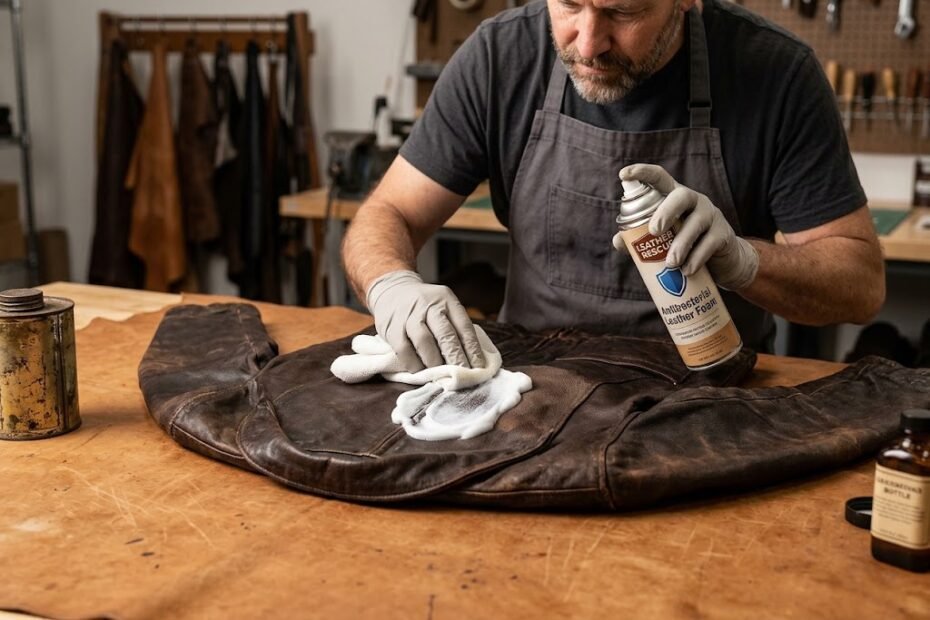
Whether you have just acquired a vintage thrift find, returned from a crowded commute, or want to eliminate lingering bacteria after seasonal storage, sanitizing your outerwear is a critical hygiene priority. However, grabbing standard household disinfectant wipes or alcohol sprays can quickly lead to disaster.
The central dilemma for leather enthusiasts is clear: how to disinfect leather jacket materials thoroughly without stripping the essential tanning oils, degrading the top pigment layer, or causing the hide to crack and dry out.
Leather is an organic, porous material derived from animal collagen. Harsh chemical biocides like isopropyl alcohol, bleach, and quaternary ammonium compounds dissolve the delicate protective finish, leading to permanent chemical burns. In this 1,500-word definitive masterclass, we break down the biochemical interaction between sanitizers and tanned hides, expose common cleaning traps, and provide a 4-step, non-destructive protocol on how to disinfect leather jacket outerwear to safeguard your health and your investment piece leather jacket.
I. The Material Chemistry: Why Standard Disinfectants Ruin Hides
To understand the science of how to disinfect leather jacket surfaces without triggering structural breakdown, you must understand how animal skin is preserved. Authentic leather consists of a dense network of collagen fibers infused with specialized fatliquors (natural oils and waxes) during the tanning process.
According to material research tracked by the Leather Working Group (LWG), biological hides maintain an acidic surface barrier known as the acid mantle (pH 4.5–5.5). When you apply conventional household disinfectants:
Alcohol-Driven Lipid Extraction: Isopropyl alcohol acts as a powerful solvent. It rapidly dissolves and extracts the fatliquors from the dermal pores. As the solvent flashes off, the collagen bundles contract and stiffen, creating microscopic surface fractures that lead directly to how to repair cracked leather scenarios.
Bleach-Induced Protein Denaturation: Chlorine bleach has an alkaline pH of 11–13. When in contact with acidic leather, it oxidizes the top pigment layer, triggers severe chemical discoloration, and denatures the underlying protein matrix.
Lining Glue Delamination: Liquid antiseptics that saturate seams weaken the specialized glues securing the leather jacket lining, causing interior fabric puckering and premature tearing.
II. The Disinfection Matrix: Safe vs. Hazardous Agents
Knowing how to disinfect leather jacket outerwear requires distinguishing between leather-safe sanitizing agents and destructive household chemicals:
| Sanitizing Agent | Safety on Genuine Leather | Impact on Collagen & Tanning Oils | Recommended Usage |
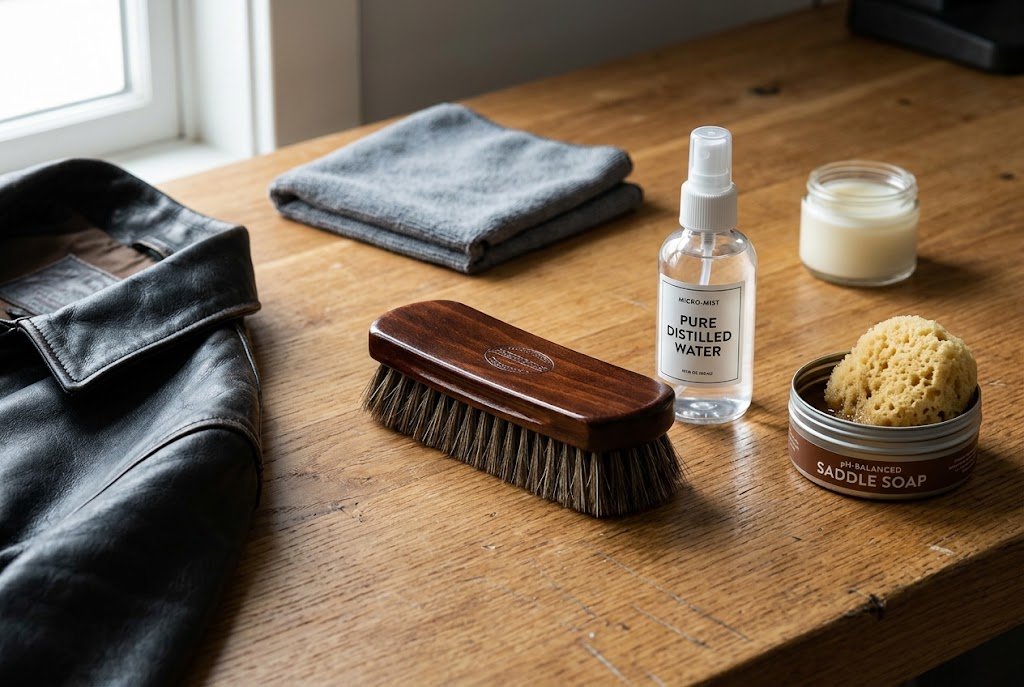
| pH-Balanced Saddle Soap | 100% Safe | Cleanses bacteria while maintaining fatliquors | Primary method for regular exterior sanitization |
| Distilled White Vinegar (1:2 Dilution) | Safe | Mild natural antimicrobial; balances natural pH | Best for lining deodorization and mild mold removal |
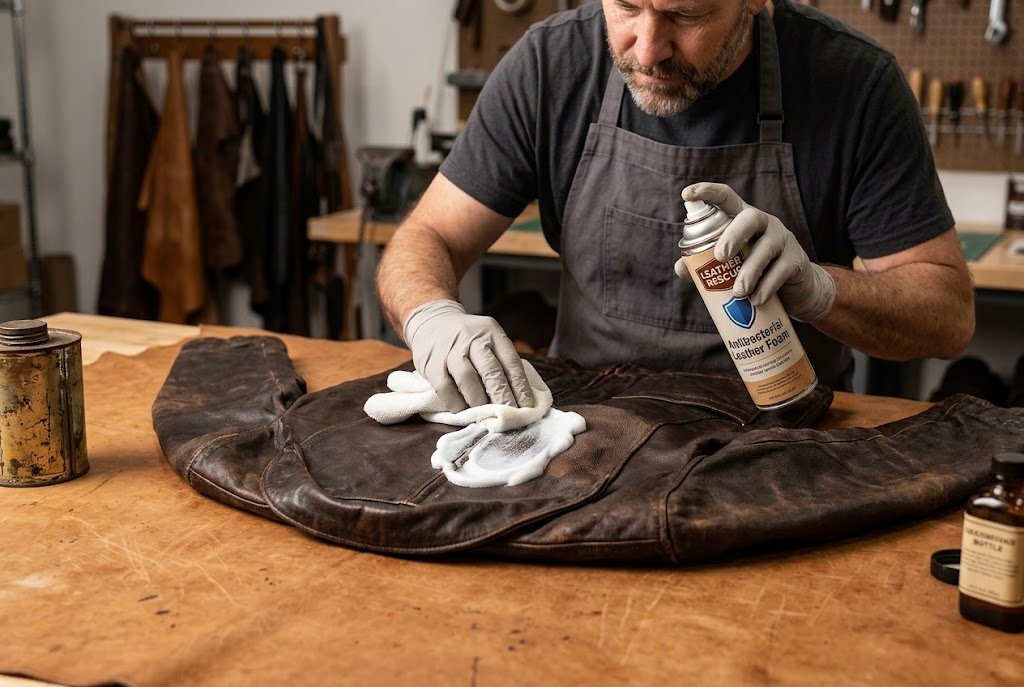
| Specialized Leather Antibacterial Foam | 100% Safe | Designed for hides; preserves natural elasticity | Ideal for high-contact areas (collar, cuffs, pockets) |
| Isopropyl / Rubbing Alcohol (70%+) | Extremely Hazardous | Rapidly dissolves fatliquors; causes deep cracking | Strictly Avoid on outer shell |
| Chlorine Bleach / Clorox Wipes | Fatal to Leather | Strips pigments; causes chemical burns & peeling | Strictly Avoid on all leather goods |
III. 4-Step Protocol: How to Disinfect Leather Jacket Outerwear Safely
To ensure deep antimicrobial protection without compromising the material, follow this systematic, non-destructive disinfection framework.
Step 1: Deep Vacuuming & Mechanical Particle Removal
Before applying any liquid sanitizer, you must eliminate dry dust, skin cells, and ambient debris where bacteria settle.
Turn the garment inside out. Using a soft-bristle brush attachment on a low-suction vacuum, clean along the internal seams, under the armpits, and inside the pocket bags.
Return the jacket right side out and gently brush the outer grain with a 100% horsehair brush, following our best practices on how to clean a leather jacket.
Step 2: The Two-Zone Disinfection Method
A critical principle in how to disinfect leather jacket garments is treating the exterior hide and interior textile lining as two distinct biological zones:
Zone A: The Exterior Shell (Antibacterial Foam Cleansing): Lightly dampen a clean, lint-free microfiber cloth with lukewarm distilled water. Squeeze out excess liquid until barely damp. Apply a coin-sized amount of specialized antibacterial leather cleaner or pH-neutral saddle soap. Work into a fine, low-moisture foam. Wipe down the entire exterior in circular motions. Immediately wipe away excess foam with a dry microfiber cloth.
Zone B: The Interior Fabric Lining (Antimicrobial Mist): Mix 1 part distilled white vinegar with 2 parts distilled water and 2 drops of tea tree oil (a natural antimicrobial) in a fine-mist spray bottle. Lightly mist the inner lining fabric—especially around the collar and armpits—avoiding direct overspray onto the outer hide. For lingering odors, consult our guide on how to get rid of leather smell.
Step 3: Controlled Ambient Drying
Moisture left inside dark closets promotes bacterial regrowth and mold spores.
Hang the sanitized garment on a wide, contoured wooden hanger to preserve shoulder geometry and avoid tension across the seams.
Allow the jacket to dry naturally in a cool, well-ventilated space for 24 to 36 hours. Never use hair dryers, radiators, or direct sunlight to speed up drying, as high temperatures cause hydrothermal shrinkage. Learn proper off-season hanging in our leather jacket storage tips.
Step 4: Re-Lipidation and Conditioning Barrier
Every disinfection cycle extracts a minute amount of moisture. To prevent brittleness, you must replenish the lipid layer.
Once fully dry, apply a thin, even coat of lanolin- or beeswax-based leather conditioner across all exterior panels.
Massage the balm into the pores using your fingertips, following our proven methods on how to stop leather from cracking and how to soften stiff leather.
IV. Material-Specific Guidelines: Tailoring Care to Your Hide
Different leather types require adjusted sanitizing approaches depending on their finishing methods:
Lambskin / Sheepskin: Because delicate hides like what is lambskin leather and what is sheepskin leather feature thin, open-grained structures, avoid wet friction. Use specialized leather sanitizing foam and immediately buff dry.
Heavy Cowhide & Steerhide: Robust materials like what is cowhide leather used in mens motorcycle jackets and motorcycle leather jackets handle gentle saddle soap washes effectively.
Full-Grain vs. Top-Grain: When assessing full grain vs top grain leather, uncorrected full-grain hides absorb sanitizing moisture faster; apply minimal dampness to prevent water rings.
Suede & Nubuck: Never use liquid sanitizers or saddle soap on suede. Use ultraviolet-C (UV-C) sanitizing wands or dry antimicrobial powders combined with a crepe suede brush.
According to material testing protocols from the American Leather Chemists Association (ALCA), matching cleaning agents to hide thickness and finish type reduces the risk of pigment delamination by over 80%.
V. Structural Fit and Sanitization Precautions
When executing how to disinfect leather jacket routines, paying attention to the garment’s cut and construction preserves its long-term silhouette:
Collar and Neckband Stress: The collar absorbs the highest concentration of hair oils and sweat. Gently cleanse this zone with an antibacterial wipe formulated specifically for leather, preventing oil build-up from degrading the leather grain.
Armhole Tension Management: Saturated linings can shrink if dried improperly, causing uncomfortable tightness around the shoulders. If you have an athletic build, maintaining proper flexibility prevents leather jacket armholes too tight restrictions.
Hardware Maintenance: Wipe down metal snaps and ykk vs sbs zippers with a dry cotton swab to eliminate trapped moisture and prevent oxidation.
VI. FAQ: Critical Leather Disinfection Questions
Can I use Lysol or Clorox disinfectant wipes on a leather jacket?
No. Most commercial disinfectant wipes contain high concentrations of alcohol and bleach derivatives that dissolve the top protective coating, leaving white chemical marks and causing peeling leather jacket damage. Always choose leather-specific antibacterial wipes.
Can you disinfect a leather jacket in a washing machine or with steam?
Never put leather in a washing machine or apply high-temperature steam. Hot steam causes irreversible collagen shrinkage and separates internal linings. For detailed explanations on machine risks, review our guides on can you wash a leather jacket and how to clean leather jackets.
How do I kill mold spores on a leather jacket found in storage?
Mix equal parts distilled water and rubbing alcohol strictly on a cotton swab to spot-treat isolated mold colonies, or use white vinegar for broad coverage. Wipe clean immediately, dry completely in a ventilated room, and rehydrate the area with a deep conditioner as outlined in our leather jacket care guide.
VII. Conclusion: Preservation Meets Hygiene
Mastering how to disinfect leather jacket outerwear proves that you do not have to choose between clinical hygiene and garment preservation. By avoiding harsh alcohols, adopting the two-zone cleaning method, and restoring essential oils with dedicated conditioners, your outerwear remains sanitary, supple, and ready for decades of wear.
At Caesar Jackets, we craft authentic, heirloom-grade outerwear built from premium, ethically sourced hides. Whether you are investing in timeless mens leather jackets, exploring versatile mens casual jackets, or looking for iconic styles like mens bomber jackets and mens classic jackets, our collections deliver craftsmanship designed to endure real-world wear.
Explore our curated range of black leather jackets, rich brown leather jackets, and elegant womens leather jackets to find outerwear built for life.