Staring at a soiled collar, grease stains on the chest, or lingering weekend odors on your favorite outerwear often prompts an urgent question: can you put leather in the washer on a gentle cycle, or will home laundering permanently destroy your prized garment?
The definitive answer from professional tanners and garment restorers is an unequivocal no—you must never put genuine leather in a washing machine.
Submerging an organic hide in a washing machine strips away vital tanning oils, triggers severe dimensional warping, and leaves the garment dry, brittle, and unwearable. In this 1,500-word comprehensive masterclass, we break down the exact physical and chemical degradation that occurs inside an appliance, why internet “gentle cycle” hacks fail, and how to execute safe, professional-grade manual cleaning to protect your investment piece leather jacket for decades.
I. The Machine Wash Trap: 4 Catastrophic Failure Points
To understand why asking can you put leather in the washer ends in disaster, you must understand the biochemical structure of processed hides. Genuine leather consists of dense animal collagen fibers cross-linked with natural oils and waxes during the tanning process.
According to material standards outlined by the Leather Working Group (LWG), subjecting genuine hides to machine agitation triggers four structural failures:
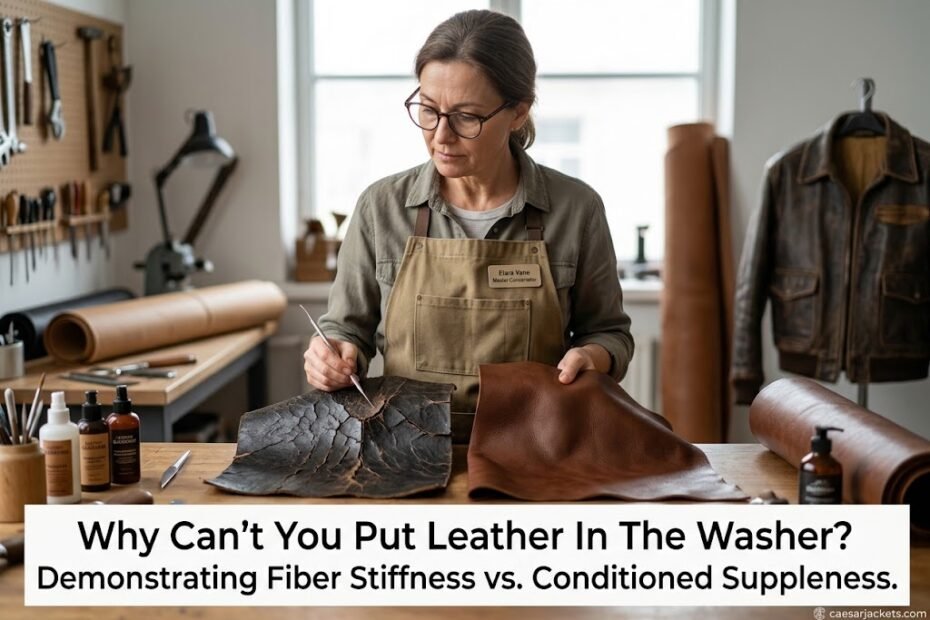
Emulsification and Loss of Fatliquors: Machine washing forces water deep into the dermis. As the water evaporates during drying, it binds with and extracts the essential fatliquors (lubricating oils) placed during tanning. Without these oils, the collagen bundles cross-link into rigid structures, turning soft hides into stiff, cardboard-like sheets.
Hydrothermal and Dimensional Shrinkage: Even on “cold” cycles, mechanical twisting combined with saturation causes the protein matrix to contract unpredictably. This creates permanent puckering along the seams and uneven shrinkage across panels.
Lining and Adhesive Delamination: The interior glues that secure the leather jacket lining dissolve in water, causing the fabric to separate, bunch, and tear at the armholes.
Hardware Abrasion and Surface Micro-Tears: The friction of metal rivets, snap buttons, and heavy ykk vs sbs zippers abrades the top grain during drum rotation, stripping the protective pigment and creating deep surface gashes.
II. The Myth of the “Gentle Cycle”: Real vs. Faux Leather in Water
Many lifestyle blogs claim that if you use cold water and mesh laundry bags, can you put leather in the washer becomes safe. This advice confuses synthetic vinyl with authentic hide:
| Performance Characteristic | Genuine Animal Leather (Lambskin/Cowhide) | Synthetic Faux Leather (PU/PVC) |
| Material Base | Biological Collagen Fiber Matrix | Petroleum Polymer on Woven Fabric |
| Reaction to Submersion | Strips natural oils; causes irreversible hardening | Water-resistant surface; backing absorbs water |
| Agitation Impact | Severe grain abrasion and joint warping | Triggers leather jacket peeling and delamination |
| Safe Cleaning Protocol | Surface wiping with pH-neutral saddle soap | Spot cleaning with mild soapy water |
| Recovery Feasibility | Requires deep fatliquor reconditioning | Cannot be repaired once plastic layers separate |
According to technical research from the American Leather Chemists Association (ALCA), synthetic polyurethanes (PU) may survive water contact, but mechanical agitation shears the thin adhesive layer bonding the polymer skin to the base mesh, causing rapid flaking. Whether your jacket is real or synthetic, machine washing remains destructive.
III. 4 Safe Methods to Clean Leather Without a Washing Machine
Instead of risking irreversible destruction in an appliance, use these non-destructive cleaning protocols tailored to specific types of dirt, stains, and odors.
Method 1: The pH-Balanced Saddle Soap Surface Clean
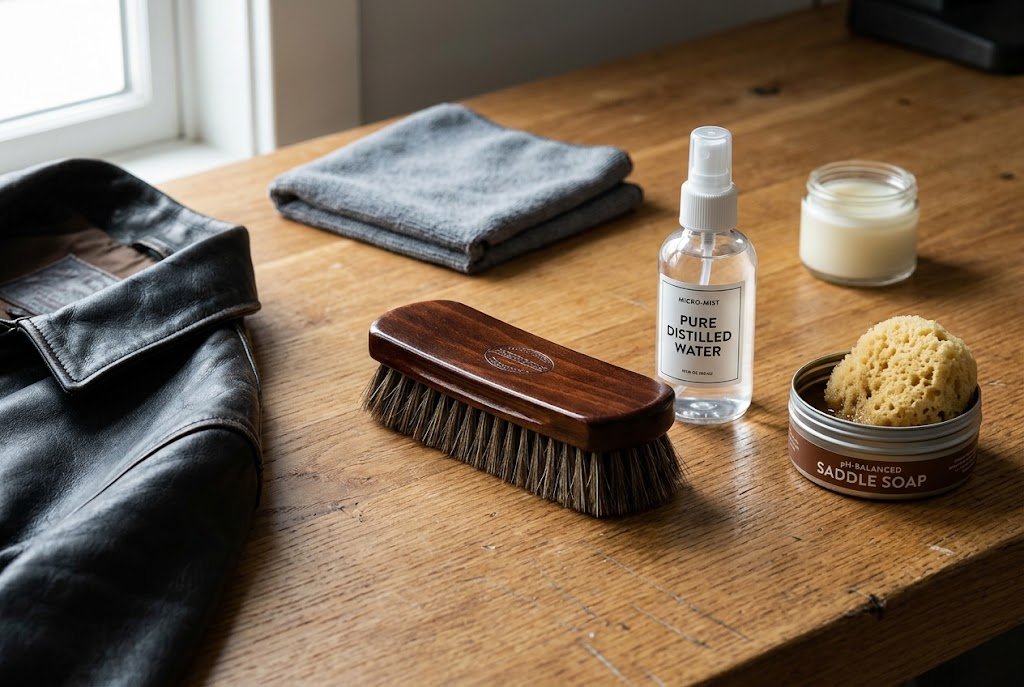
For overall grime, dust, and light street residue, surface foaming with saddle soap is the industry gold standard.
Step 1: Lightly dampen a microfiber cloth with lukewarm distilled water. Wring it out until it is barely moist.
Step 2: Rub a small amount of pH-neutral saddle soap onto the cloth to create a light, low-moisture foam.
Step 3: Gently wipe the exterior panels in smooth, circular motions. Never scrub aggressively, as friction can wear away the finish on delicate what is lambskin leather.
Step 4: Wipe away residue with a dry microfiber cloth, then review our steps on how to stop leather from cracking to rehydrate the grain.
Method 2: Spot-Cleaning Deep Grease and Oil
Water and detergents spread oil deeper into leather pores. To extract oil safely:
The Absorbent Powder Technique: Sprinkle cornstarch or talcum powder directly over the stain. Let it rest for 8 to 12 hours. The powder draws the lipid molecules out through capillary action. Gently brush away the residue with a soft horsehair brush. For deeper scuffs, consult our guide on how to remove scratches from leather jacket surfaces.
Method 3: Deodorizing the Interior Lining Safely
When body odors or sweat accumulate inside the jacket, you can refresh the lining without soaking the outer shell:
Turn the jacket inside out and suspend it on a wide wooden hanger.
Mix a 1:2 solution of distilled white vinegar and water in a fine-mist spray bottle.
Mist the armpit and collar linings lightly, ensuring no moisture penetrates through to the leather shell. Vinegar neutralizes bacteria naturally and dissipates as it dries. For persistent mustiness, consult our detailed walkthrough on how to get rid of leather smell.
Method 4: Professional Leather Dry Cleaning
If your jacket is covered in heavy mud, dye transfers, or road salt, home treatments are insufficient. Never use standard commercial dry cleaners that utilize perchloroethylene, as harsh chemicals dissolve natural oils instantly. Look for an expert leather dry cleaner who uses hydrocarbon- or silicone-based fluid replenishment baths.
IV. Post-Wash Disaster Recovery: How to Save an Accidentally Washed Jacket
If you or someone in your household has already run your jacket through a laundry cycle, act immediately to mitigate fiber damage:
Accidentally Washed Jacket ──► Towel Blotting ──► Wide Wooden Hanger ──► 48h Ambient Air Drying
 ──► Lanolin Conditioning Buff
Do Not Apply Direct Heat: Never put a wet leather garment in a tumble dryer or near a space heater. High heat bakes the collagen triple-helix structure, causing irreversible brittleness.
Absorb Bulk Moisture: Lay the jacket flat on thick, dry bath towels. Roll the towels up with the jacket inside and press gently to extract excess water without wringing.
Maintain Shoulder Structure: Transfer the jacket to a wide, contoured wooden hanger in a well-ventilated room, following our leather jacket storage tips.
Reintroduce Lost Moisture: Once the leather is dry to the touch but still slightly cool, apply a rich, lanolin- or beeswax-based leather conditioner. Work the balm in with your fingers, following our guides on how to soften stiff leather and how to break in a leather jacket to restore suppleness.
V. FAQ: Washing Machine & Leather Care Essentials
What happens if I wash a faux leather jacket in the machine?
While synthetic PU repels liquid, machine agitation breaks the adhesive bond between the plastic coating and the inner woven mesh, leading to extensive how to fix peeling leather jacket issues. Hand wiping remains the safest approach.
Can heavy motorcycle riding gear be machine washed?
No. Rugged cowhide used in mens motorcycle jackets and protective motorcycle leather jackets is thick and dense. Machine washing strips the heavy protective waxes, leaving the hide prone to seam splitting upon impact. Clean the outer shell with saddle soap and remove the internal armor pads for separate hand washing.
How often should a genuine leather jacket be cleaned?
Wiping down the exterior with a damp cloth should be done seasonally, while deep conditioning should occur every six months according to our leather jacket care framework. For comprehensive routine steps, read our guide on how to clean leather jackets.
VI. Conclusion: Protect Your Outerwear Investment
So, can you put leather in the washer under any circumstances? The answer remains a definitive no. Washing machines strip essential tanning oils, shrink seam allowances, and cause irreversible damage to natural collagen fibers. By adopting targeted spot cleaning, pH-balanced saddle soaps, and regular conditioning, you preserve the natural grain, drape, and durability of your outerwear for decades.
At Caesar Jackets, every piece of outerwear is cut from authentic, premium hides engineered for durability and character. Whether you are investing in classic mens leather jackets, casual daily layers like mens casual jackets, iconic silhouettes like mens bomber jackets and mens classic jackets, or tailored womens leather jackets, our collections are designed to age with a rich patina through simple, proper care.
Explore our curated selection of black leather jackets and brown leather jackets to find timeless, heirloom-grade outerwear built to last.