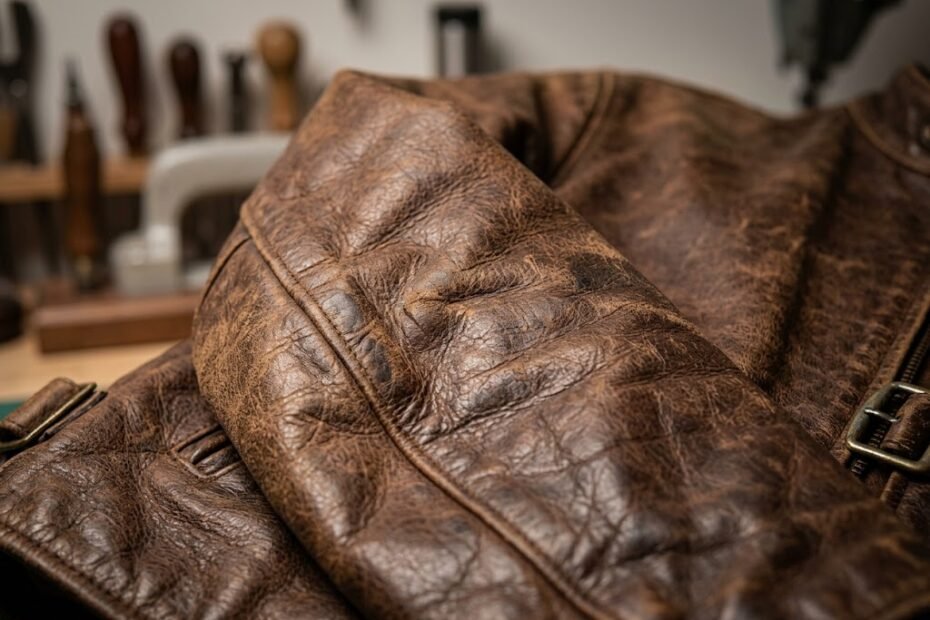
When investing in high-end outerwear, furniture, or footwear, durability is the single most important metric on every buyer’s mind. Unlike fast-fashion garments engineered for planned obsolescence, authentic animal hides have held a legendary reputation for enduring across generations. Yet, before spending your hard-earned money on a premium wardrobe staple, it is essential to ask: how long does leather last under everyday, real-world conditions?
Under proper care and reasonable environmental conditions, high-quality genuine leather lasts between 20 to 50+ years, frequently outliving its original owner to become a cherished family heirloom. High-grade hides do not crack, peel, or disintegrate like petroleum-based synthetics. Instead, their dense structural fibers adapt to your movements, developing a rich, lustrous patina that actually enhances the garment’s aesthetic value over time.
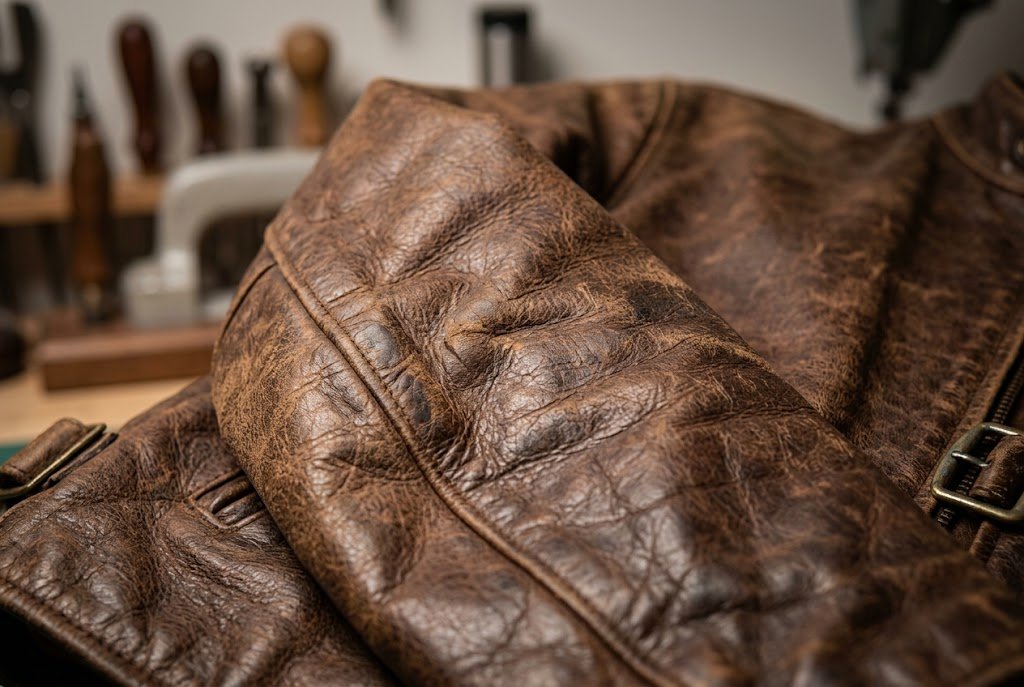
However, the real-world answer to how long does leather last depends heavily on five foundational factors: the anatomical grade of the cut, the animal source, the tanning chemistry, environmental exposure, and your routine maintenance habits. Understanding these core variables ensures you choose a piece built to survive decades of continuous wear.
1. Hide Anatomy: How Leather Grades Dictate Lifespan
The primary factor determining how long does leather last is the specific layer of the animal hide utilized during the manufacturing process. A raw animal skin is composed of dense collagen protein bundles that gradually loosen and weaken as you move deeper toward the flesh side.
Full-Grain Leather: 30 to 50+ Years (Generational Longevity)
Full-grain leather utilizes the absolute outermost layer of the hide with the grain surface left entirely intact. Because this epidermal layer contains the densest, most tightly interlocked fiber matrix, it provides maximum natural resistance to moisture, surface abrasions, and mechanical stress.
Full-grain outerwear never peels or flakes. Instead of deteriorating, it absorbs ambient oils and natural wear to produce an authentic vintage luster. To master the art of verifying raw hide grades before purchasing, check our expert guide on how to identify full-grain leather.
Top-Grain Leather: 15 to 25 Years (Polished Luxury)
Top-grain leather is created by splitting away the outermost blemish layer and lightly sanding the surface to remove natural scars and imperfections. A thin protective pigment or topcoat is then applied over the grain.
While slightly less fibrous than full-grain, top-grain remains remarkably durable, lightweight, and naturally stain-resistant. It serves as the standard baseline for tailored luxury coats. For a technical analysis between these two premier tiers, see our breakdown on top-grain vs full-grain leather.
Genuine / Split Leather: 5 to 10 Years (Budget Grade)
Despite the convincing marketing name, “genuine leather” refers to the lower fibrous split (corium) left behind once the top-grain layer has been removed. Because it lacks the protective, dense grain layer, it is weaker and more prone to stretching out of shape. While still superior to plastic imitations, split-grade leather requires diligent conditioning to prevent fiber drying and surface cracking.
2. Animal Hide Comparison: Which Skins Last the Longest?
Not all animal hides age at the same speed. The natural habitat, thickness, and collagen density of each animal yield distinct structural characteristics:
Cowhide & Steerhide (30 to 50+ Years): The gold standard for heavy-duty protection. Extremely dense, thick, and abrasion-resistant, cowhide is the premier choice for motorcycle armor and winter outerwear.
Goatskin (25 to 40 Years): Naturally rich in lanolin oils, goatskin features a distinctive pebbled grain that makes it exceptionally supple, lightweight, and scratch-resistant.
Lambskin & Sheepskin (15 to 25 Years): Celebrated for its buttery, featherweight touch. While softer and more delicate than heavy cowhide, quality lambskin maintains structural integrity when kept hydrated. For insights into choosing the best hide for your needs, read our guide on which leather is best for a leather jacket.
Suede & Nubuck (10 to 20 Years): Suede is crafted from the napped inner split of the hide. While supple and velvety, its open fibrous texture is sensitive to moisture and stains, requiring dedicated protective sprays.
3. Real Leather vs. Faux Leather: Longevity Benchmark Matrix
To understand how long does leather last compared to modern synthetic alternatives, examine the performance benchmark matrix below.
| Material Variety | Average Expected Lifespan | Primary Failure Mode | Aging Behavior | Repair Potential |
| Full-Grain Real Leather | 30 to 50+ Years | Fiber dehydration (preventable) | Gains a rich vintage patina | High (re-conditionable/dyeable) |
| Top-Grain Real Leather | 15 to 25 Years | Surface finish wear | Softens gradually over time | High (touch-up & polish) |
| Real Suede Hide | 10 to 20 Years | Water staining / matting | Softens; loses surface nap | Moderate (suede brushing) |
| Polyurethane (PU) Faux | 2 to 5 Years | Delamination & flaking | Cracks and flakes away | Almost zero |
| PVC Vinyl Faux | 2 to 4 Years | Plasticizer evaporation | Hardens, splits at seams | Unrepairable |
As the data proves, authentic leather easily outlasts plastic-bonded synthetic alternatives by a factor of ten. For a deeper look at the synthetic degradation timeline, see our analysis answering can faux leather jackets last long.
4. Why Does Real Leather Outlast Synthetics?
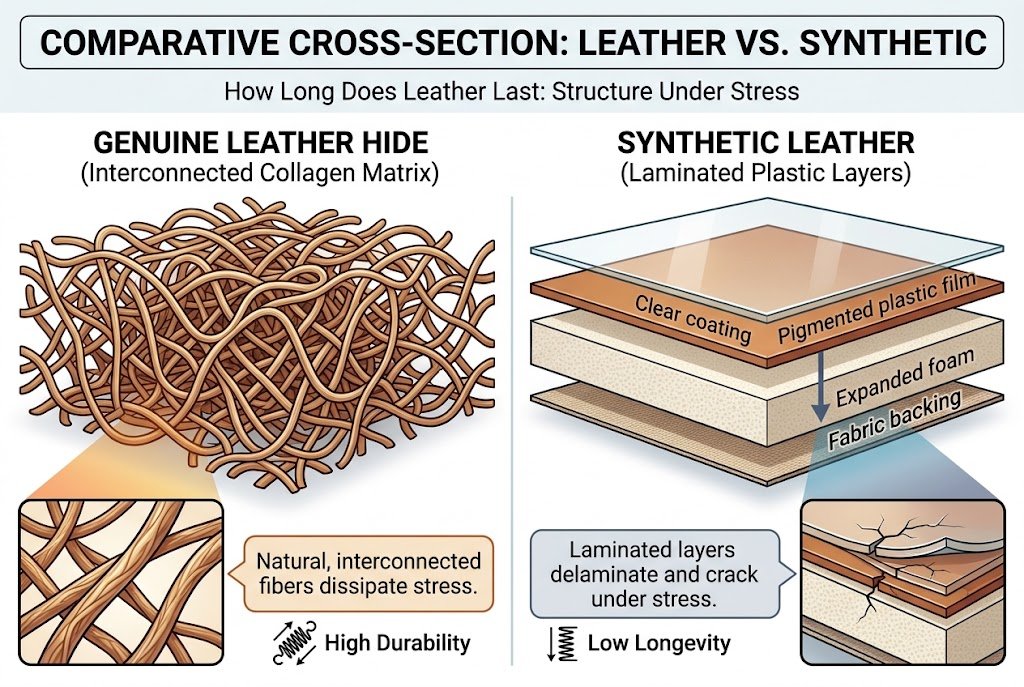
The longevity of natural hides comes down to cellular chemistry. Real animal skin is composed of three-dimensional, cross-linked collagen protein chains. When tanned correctly, these natural collagen networks create a breathable, flexible membrane that stretches under physical pressure and snaps back without breaking.
Plastic synthetic outerwear (PU or PVC), by contrast, consists of petroleum polymers glued onto a woven textile mesh. Because synthetic materials cannot breathe, natural body movements exert shear stresses on the glue bond. Over several seasons, environmental moisture causes hydrolysis, causing the plastic coating to separate, crack, and flake away.
To witness how a real investment piece transforms across an extended lifecycle, explore our case study on a leather jacket after 10 years of daily wear.
5. Five Golden Rules to Make Leather Last 50+ Years
Even the most indestructible full-grain hide will degrade prematurely if neglected. Follow these five core maintenance rules to maximize your outerwear’s operational lifespan:
Rule 1: Hydrate Every 6 to 12 Months
Leather contains natural oils that evaporate over time. Applying a specialized leather conditioner replenishes these essential lipids, preventing the fibrous matrix from drying out and cracking. Follow our step-by-step leather jacket care guide for routine conditioning methods.
Rule 2: Never Apply Direct Heat
If your coat gets soaked in a rainstorm, let it air-dry naturally at room temperature on a wide hanger. Applying a hair dryer or placing it near a radiator cooks the collagen fibers, causing permanent warping and shrinkage.
Rule 3: Store on Wide, Padded Hangers
Thin wire hangers concentrate the jacket’s weight onto tiny points, distorting the shoulder seams and stretching the leather out of shape. Always use a contoured wooden or padded hanger.
Rule 4: Ensure Ambient Airflow
Never store leather inside sealed plastic dry-cleaning bags. Leather requires natural air circulation; trapped humidity triggers mold blooms, while stagnant dry air parches the surface. Review our instructions on how to store a leather jacket in summer.
Rule 5: Treat Scratches and Holes Early
Minor surface snags can be moisturized away, and punctures can be stabilized before they spread. If you encounter an accidental tear, use our tutorial on how to fix hole in leather jacket to restore the damaged panel.
6. Sustainable Craftsmanship and Environmental Standards
Maximizing longevity is the cornerstone of sustainable fashion. Investing in a single authentic garment that endures for four decades eliminates the ecological toll of manufacturing, shipping, and discarding a dozen disposable synthetic jackets.
Organizations like the Leather Working Group evaluate international tanneries on strict environmental standards, covering water stewardship, energy efficiency, and non-toxic chemical recycling. Choosing outerwear made from certified hides guarantees that your leather has been processed without degrading the raw fiber matrix, ensuring decades of clean, reliable wear.
Conclusion: An Investment Built to Outlast Trends
The answer to how long does leather last comes down to quality craftsmanship paired with routine care. While cheap imitation fabrics break down within a few seasons, authentic full-grain and top-grain hides are engineered by nature to deliver 30 to 50+ years of high-performance elegance.
Choose full-grain or top-grain for lifetime structural endurance.
Condition the hide annually to maintain moisture balance.
Store on structured hangers away from direct heat and damp environments.
When treated with care, your leather jacket becomes more than outerwear—it becomes a signature companion that records your personal history.
Discover Your Lifetime Outerwear Today
Are you ready to invest in heirloom-quality craftsmanship built for the long haul? Explore our handcrafted selection of mens leather jackets to find timeless biker, bomber, and racer styles. Looking for butter-soft, elegant luxury that drapes like a second skin? Discover our curated womens leather jackets collection and secure your signature investment piece for 2026.