Buying a premium leather jacket online is one of the most exciting upgrades you can give your personal style, but it is also an exercise in high-stakes precision. Unlike a flexible cotton hoodie or a loose linen shirt, real leather is an unforgiving material. It doesn’t stretch easily over a surprise midsection, it won’t drape elegantly if the shoulders are too wide, and getting it tailored after the fact is an incredibly complex, expensive nightmare. Navigating a comprehensive leather jacket sizing guide for men isn’t just about looking at a generic small, medium, or large tag—it is about understanding the exact physical architecture of your upper body and how a dense animal hide reacts to your movements.
In 2026, global menswear has shifted dramatically away from the oversized, baggy streetwear trends of the past decade toward structured, intentional silhouettes. Owners want their outerwear to look custom-made, highlighting their frame while allowing enough functional mobility for daily life. To help you avoid the dreaded cycle of return shipping and structural disappointment, you need a hardcore measurement strategy. This operational leather jacket sizing guide for men breaks down the exact steps to map your body, decode brand charts, and secure a second skin that fits flawlessly from the first wear.
The Holy Trinity of Leather Measurements: Chest, Shoulders, and Sleeves
When you open any brand’s online sizing chart, you will be bombarded with numbers. However, to achieve a perfect drape, you only need to master three critical dimensions. Grab a flexible fabric measuring tape and a friend—measuring yourself accurately alone is nearly impossible.
The Chest Foundation
Your chest measurement is the primary anchor that dictates your baseline size across 90% of global outerwear brands.
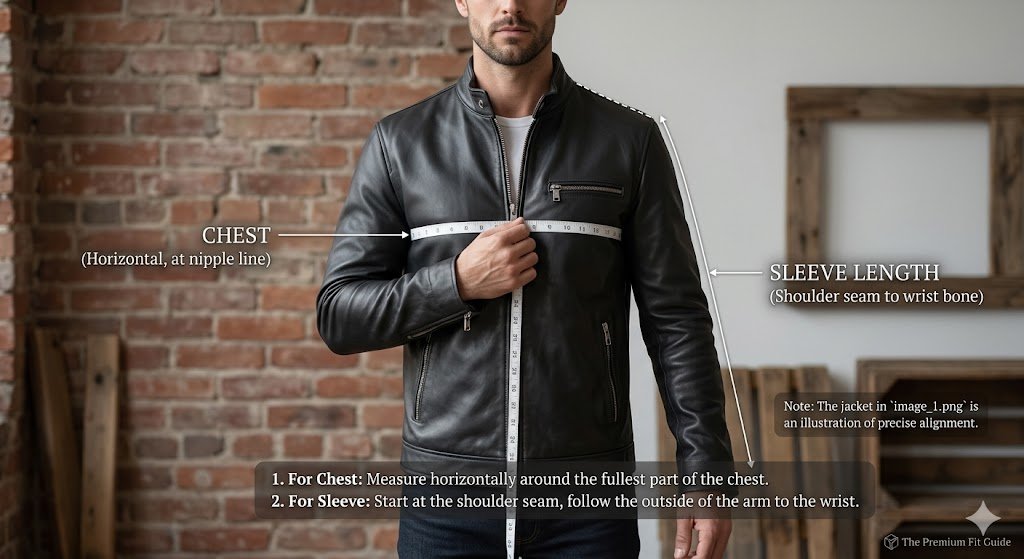
To measure your chest, wrap the fabric tape under your armpits, across the widest part of your shoulder blades, and over the peak of your nipples. Keep the tape completely parallel to the floor and relax your arms down naturally at your sides; do not puff out your chest or hold your breath, as this will artificially inflate the number and lead to a baggy fit.
The Shoulder Drop Alignment
The shoulder construction is the most difficult element to modify on a hide, making it the absolute make-or-break metric of this leather jacket sizing guide for men.
Locate the exact point where your horizontal shoulder bone ends and drops off sharply into your upper arm muscle. Measure straight across your upper back from one shoulder point to the other. If the jacket’s seams sit past this point, you will look top-heavy and sloppy; if they sit too high, your arm movement will be severely choked. For a deep look at how specific cuts handle shoulder structures, review our full breakdown of mens leather jacket styles.
The Sleeve Length Sweet Spot
Leather jacket sleeves behave differently than suit jacket sleeves because they do not ride up as easily over a dress watch.
Extend your arm slightly, with a soft bend at the elbow. Measure from the top shoulder point down along the outer edge of your arm to the base of your thumb joint. A perfectly fitted sleeve should hit exactly at your wrist bone when your arm is hanging down. If you end up buying a vintage piece with sleeves that swallow your hands, check out our structural troubleshooting guide on leather jacket sleeve length too long fixes to plan a remedy.
Understanding Garment Measurements vs. Body Measurements
The single most common mistake men make when utilizing a leather jacket sizing guide for men online is confusing their raw physical body metrics with the dimensions of the actual jacket.
If your physical chest measures exactly 40 inches, buying a jacket with a garment chest specification of 40 inches means you will not be able to physically zip it closed. Premium outerwear brands design a metric known as “ease” into their patterns to allow for breathing room and fabric layers.
| Target Sizing Fit Profile | Added Ease to Body Chest | Best Used For |
| Slim / Racer Fit | + 2 Inches to garment chest | Light summer tees and low-profile evening looks. |
| Regular / Bomber Fit | + 3 to 4 Inches to garment chest | Standard daily utility and balanced transitional weather. |
| Oversized / Winter Fit | + 5+ Inches to garment chest | Heavy-duty seasonal layering over thick wool pieces. |
If you prefer a tight, cafe-racer silhouette but still want to slide your jacket on over basic layers without pulling the seams out, read our operational deep-dive on what to pair with leather jacket staples.
The Dynamic Layer Test: Account for Your Seasonal Knitwear
A leather shell changes its fit dynamics entirely based on what you wear beneath it. A jacket that fits perfectly over a lightweight summer tank top can suddenly feel like a straightjacket the moment you throw it over a winter sweater.
When using this leather jacket sizing guide for men, think honestly about your primary use case. If you live in a cold climate and are shopping for a mens winter jackets selection, take your physical measurements while wearing your favorite thick layer, such as a mens patchwork sweater. This ensures the armholes and chest cavity possess the necessary volume to accommodate the fabric without causing painful armpit compression. For advanced cold-weather layout configurations, check out our masterclass on how to layer a leather jacket in winter.
Match the Animal Hide to Your Sizing Expectations
Different types of leather possess vastly distinct structural memory and elasticity. The type of animal hide you select dictates how much the jacket will stretch and adapt to your body over time.
Lambskin is incredibly thin, soft, and pliable. It features an organic elasticity that allows it to conform to your unique physical contours, meaning a snug slim fit will naturally relax into a perfect custom drape within a few weeks of consistent wear.
Conversely, heavy cowhide or steerhide possesses almost zero initial give. If a cowhide jacket feels tight or restrictive in the store, it will likely remain uncomfortable for a very long time. To study the density and stretch coefficients of these two iconic hides before making your final purchase, read our comparison on lambskin vs cowhide leather jacket performance.
Troubleshoot the Warning Signs of a Bad Fit
Once your package arrives, you must perform a rigorous physical check before removing the tags. Look out for these critical warning signs that indicate you chose the wrong size:
The “X” Zipper Tension: If you zip the front closed and notice deep, diagonal creases pulling outward from the zipper teeth across your chest forming an “X” shape, the jacket is too small.
The Back Panel Balloon: Stand sideways in a mirror. If the leather on the lower back billows outward like a sail, the waist size is too large for your torso.
The Armhole Pinch: Lift your arms straight out in front of you as if driving a car. If the leather digs deeply into your armpits or pulls violently across your upper shoulder blades, the shoulder width is too narrow. Check our emergency fix directory for leather jacket armholes too tight scenarios.
Internal and External Resources
To ensure your premium wardrobe expansion remains completely accurate, check out these authoritative fashion links:
Internal: Avoid common purchasing errors by reviewing our leather jacket buying guide.
Internal: Learn how to preserve your jacket’s natural oils post-purchase with our leather jacket care guide.
External: Visit the Leather Working Group to explore international industrial standards for premium leather processing and material safety.
External: Consult the anthropometric measurement charts at Britannica to study human body proportion dynamics across apparel design history.
The Verdict: Trust the Tape, Not the Tag
At the end of the day, mastering a leather jacket sizing guide for men comes down to one absolute rule: trust your actual measuring tape over a brand’s arbitrary letter tag. Sizing varies wildly between a European slim-cut fashion brand and a traditional American heritage label. By locking down your exact chest, shoulder, and sleeve metrics, accounting for ease and seasonal knitwear, and matching the fit profile to your specific choice of lambskin or cowhide, you eliminate the guesswork entirely. Take your time during the mapping process, measure twice, and invest in a piece of structured heritage that elevates your presence the second you slide it on.