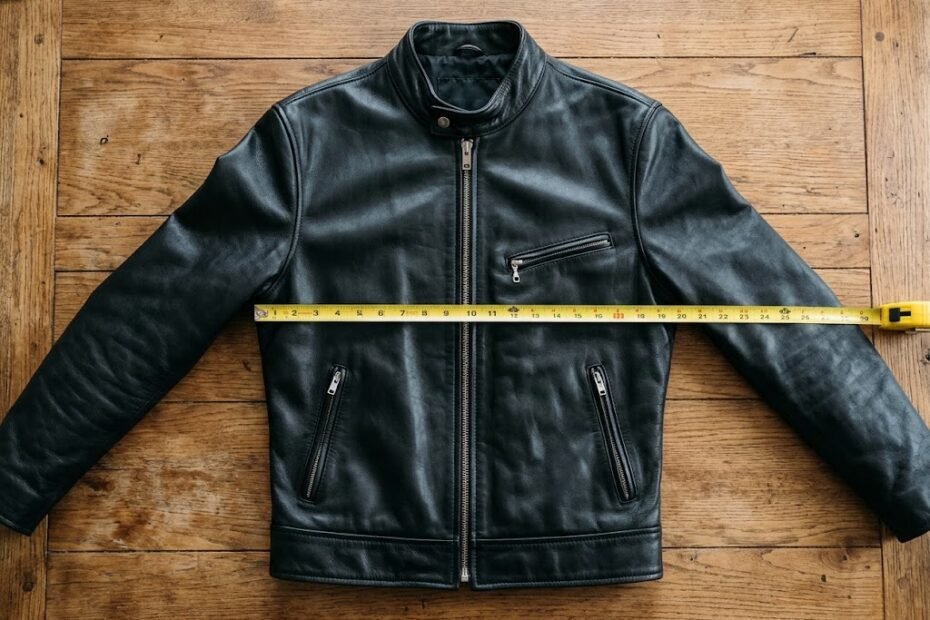
Purchasing a premium leather jacket online is one of the most exciting wardrobe upgrades you can make. The rich scent of authentic hide, the distinct tactile grain, and the sharp, structured silhouette immediately elevate your personal style. However, the excitement of unboxing your new jacket can instantly evaporate if the shoulders droop off your frame, the sleeves swallow your hands, or the chest zipper refuses to close comfortably.
Unlike knitwear, cotton hoodies, or casual denim jackets, authentic leather possesses minimal elasticity. The heavy-duty structural seams and dense collagen fibers will not stretch to accommodate an incorrect fit. This makes learning how to measure for a leather jacket the single most vital skill before clicking the checkout button.
Whether you are shopping for a vintage asymmetrical biker, a minimalist cafe racer, or an insulated sheepskin bomber, taking accurate anatomical dimensions eliminates the frustration of returns. In this comprehensive 2026 measurement guide, we will walk you through the essential tools, two distinct measuring methods, and the five critical dimensions required to secure a bespoke-level fit.
1. Preparing Your Tools and Environment
Before jumping into the process of how to measure for a leather jacket, you must set up your workstation with the correct tailoring gear. Improvised tools like rigid metal construction tape measures will skew your dimensions and lead to an ill-fitting garment.
The Essential Sizing Toolkit
Flexible Tailor’s Tape: A soft, flexible vinyl or fiberglass measuring tape that wraps smoothly around body contours.
A Well-Fitting Benchmark Jacket: A non-stretchy jacket or blazer from your current wardrobe that fits your shoulders and chest cleanly.
A Notepad or Phone: To record your exact numbers in both inches and centimeters.
A Mirror or a Friend: Having a second person hold the tape measure ensures the line remains level across your back.
Body Preparation Rules
When measuring your body directly, wear a standard base layer—such as a fitted t-shirt or a light flannel—that represents what you typically plan to wear underneath your jacket. Stand relaxed with your arms hanging naturally at your sides; puffing out your chest or sucking in your stomach will result in inaccurate numbers. If you are shopping specifically for feminine silhouettes, cross-reference your results with our dedicated womens jacket size guide for tailored cut variations.
2. Method 1: Measuring Your Body Directly (5 Core Dimensions)
The most common approach when learning how to measure for a leather jacket is taking direct anatomical measurements.
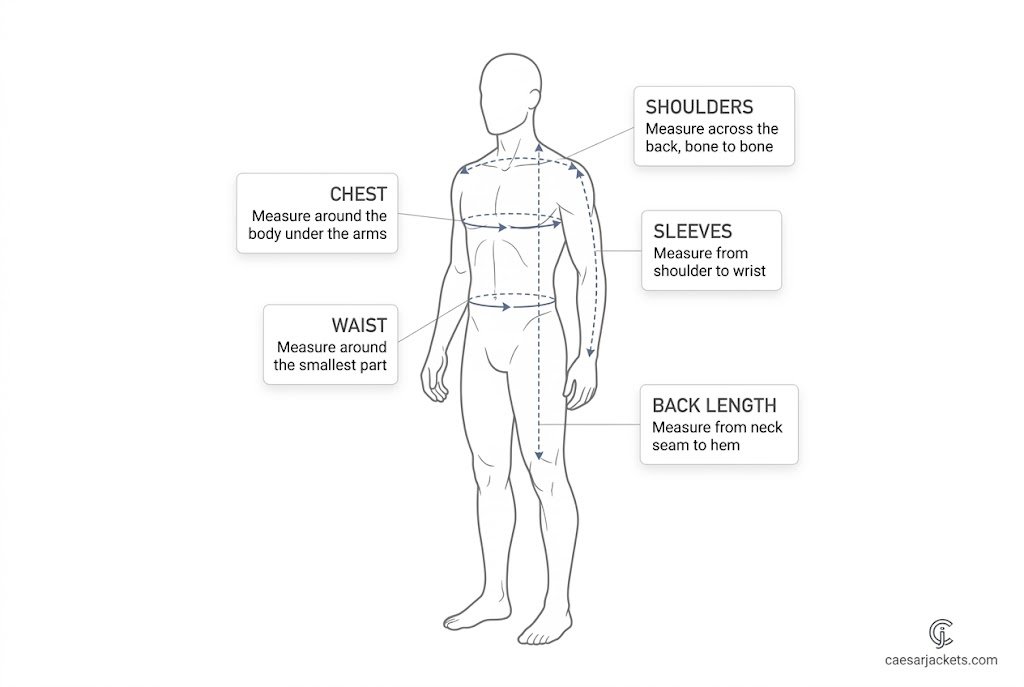
Step 1: Chest / Bust Circumference (The Primary Metric)
The chest measurement is the most critical metric for any jacket size chart.
Wrap the flexible tape around the fullest part of your chest, directly under your armpits and across your shoulder blades.
Keep the tape level and parallel to the floor.
Relax, exhale naturally, and ensure you can slip two fingers flat underneath the tape for essential breathing room.
The Allowance Rule: Add 2 to 3 inches (5 to 8 cm) to your raw chest measurement to determine your ideal jacket chest size for a standard comfortable fit.
Step 2: Shoulder-to-Shoulder Width
The shoulder seam placement defines the entire architectural drape of a leather coat.
Locate the outermost bony point of each shoulder (the acromion bone where the shoulder slope meets the upper arm).
Run the measuring tape across the natural curve of your upper back from the left shoulder tip to the right shoulder tip.
If this measurement is too narrow, arm articulation will be severely restricted; if it is too wide, the jacket will look boxy and oversized.
Step 3: Sleeve Length (Shoulder Tip to Wrist)
Stand with your arm slightly bent at the elbow (around a 30-degree angle) to mimic natural resting posture.
Place the start of the tape at the outer edge of your shoulder bone.
Run the tape down the outer curve of your arm, past your elbow, and end precisely at the base of your thumb joint or wrist bone.
Leather sleeves naturally shorten slightly as horizontal creases form at the elbow, so ensuring the sleeve hits the base of the thumb prevents high-water cuffs when riding or driving.
Step 4: Natural Waist and Sweep (Hips)
Measure around the narrowest part of your torso (your natural waistline, usually an inch above your navel).
For longer silhouettes or cropped moto jackets, measure the “sweep” (the lower circumference where the bottom hem of the jacket sits around your hips).
Ensure the waist measurement is at least 1.5 to 2 inches larger than your raw body measurement so the jacket zips comfortably over your beltline.
Step 5: Center Back Length
Place the tape measure at the prominent bone at the base of your neck (the C7 vertebra).
Run the tape straight down your spine to your desired finish point.
For classic cafe racers and biker jackets, the hem should terminate just below the beltline; for car coats and trench styles, it will extend down past the mid-thigh.
To see how these individual points interact during movement, review our masterclass on how should a leather jacket fit.
3. Method 2: The Flat-Lay Garment Measurement Method
If you already own a structured denim jacket, blazer, or casual coat that fits you like a glove, measuring the garment flat is often faster and more accurate than measuring your own body.
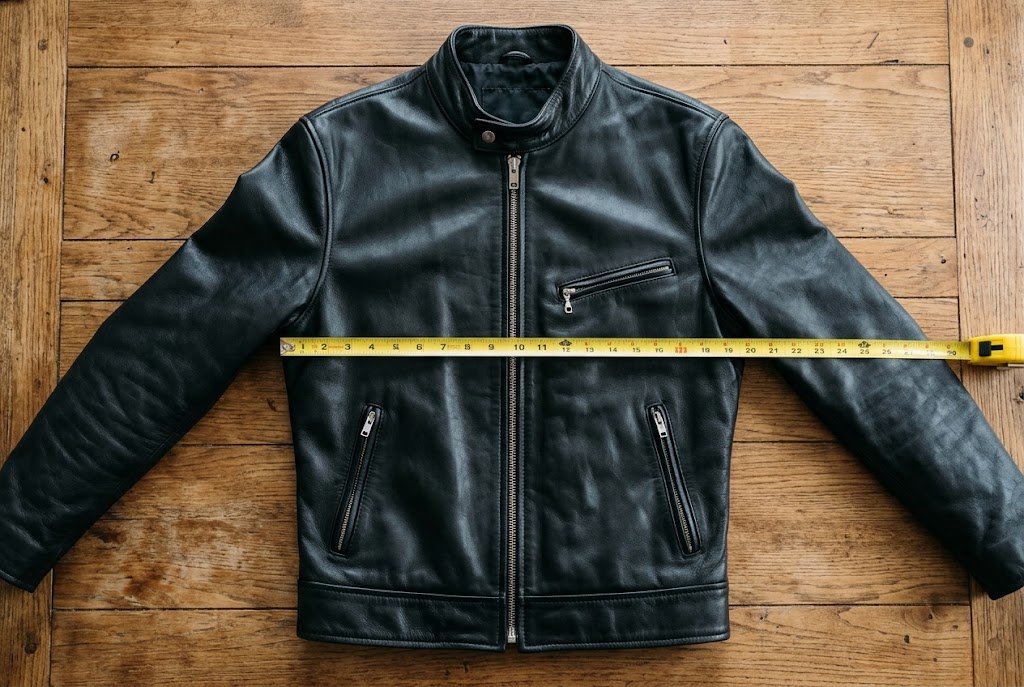
How to Execute the Flat-Lay Method:
Zip the Jacket Completely: Lay the garment face-up on a hard, flat surface (such as a dining table or hardwood floor). Smooth out all wrinkles and folds.
Pit-to-Pit (Chest Width): Measure straight across the chest from the bottom edge of the left armpit seam to the right armpit seam. Double this number to calculate the total jacket chest circumference.
Shoulder Seam to Seam: Flip the jacket face-down. Measure straight across the top back yoke from the left shoulder seam junction to the right shoulder seam junction.
Sleeve Length: Measure from the top shoulder seam down the outer edge of the sleeve to the end of the cuff.
Back Length: Measure from the bottom seam of the collar straight down the center back seam to the bottom edge of the hem.
4. Account for Leather Hide Thickness and Internal Linings
When applying what you have learned about how to measure for a leather jacket, remember that hide density impacts internal volume. A size Medium in thin, supple lambskin will feel roomier than an identical size Medium crafted from 1.4mm heavy-duty steerhide with a quilted thermal lining.
| Leather Hide Variety | Hide Weight / Density | Interior Volume Impact | Recommended Sizing Adjustment |
| Buttery Lambskin | Featherweight (0.6–0.8mm) | Negligible (Drapes closely) | True to size / Snug fit |
| Full-Grain Cowhide | Heavyweight (1.1–1.4mm) | Moderate (Requires break-in) | Add 0.5–1 inch ease |
| Goatskin / Sheepskin | Medium (0.8–1.0mm) | Low to Moderate | True to size |
| Shearling / Wool Lined | Ultra-Heavy (1.5mm+ with wool) | High (Consumes internal room) | Size up 1 full size |
If you are unsure which animal hide aligns with your seasonal needs, explore our detailed breakdown on which leather is best for a leather jacket before finalizing your measurements.
5. Five Golden Rules to Avoid Sizing Mistakes
To guarantee 100% sizing accuracy when you place your order, keep these five practical rules at the forefront of your decision:
Rule 1: Never Measure Over Heavy Outerwear
Taking your body measurements while wearing a thick cable-knit sweater or a heavy hoodie will inflate your numbers by 2 to 4 inches, resulting in a jacket that looks like an oversized tent when worn over a simple t-shirt. Measure over a thin base layer, then factor in deliberate layering ease.
Rule 2: Prioritize the Shoulders Above All Else
A leather jacket can be slightly altered by a specialist at the sleeves or side seams, but adjusting the shoulders requires deconstructing the entire collar and chest panels. If the shoulder measurement matches your body, the rest of the jacket will drape naturally. For shorter frames, consult our styling tips for the best leather jacket for petite women.
Rule 3: Factor in the “Break-In” Factor
Authentic, high-grade leather molds to your anatomy over time. Heavy cowhide will soften and form natural creases along your elbows and torso, expanding slightly in high-pressure areas. To understand how natural hides evolve across a lifetime of wear, read our longevity review on how long does real leather last.
Rule 4: Match the Silhouette to Your Wardrobe Intent
Slim / Moto Fit: Requires 1.5 to 2.5 inches of chest ease over your actual body measurement for a sharp, tailored profile.
Regular / Classic Fit: Requires 3 to 4 inches of chest ease for daily versatility and light layering.
Relaxed / Bomber Fit: Requires 4 to 5+ inches of chest ease for dropped shoulders and heavy winter hoodies.
If you are a first-time buyer comparing timeless silhouettes, save time by reviewing our buyer’s guide on what leather jacket should i buy first.
Rule 5: Check the Brand’s Specific Size Chart
Never assume you are a standard “Size Large” across all brands. Sizing varies globally between Italian, British, and American manufacturers. Always compare your recorded numbers against the brand’s exact sizing table.
6. Sustainable Craftsmanship and Sizing Longevity
A custom-fitted leather jacket is an enduring investment designed to last for decades rather than seasons. The Leather Working Group evaluates tanneries across the world for ethical practices, energy efficiency, and superior hide fiber integrity.
When you take the time to measure your body accurately and purchase a responsibly sourced leather coat, you actively participate in sustainable fashion by eliminating the carbon footprint of unnecessary shipping returns and disposable fast-fashion cycles. Once your jacket arrives, maintaining its suppleness with a proper leather jacket care guide ensures the seams and hide remain preserved for decades.
Conclusion: Securing Your Custom-Fit Masterpiece
Mastering how to measure for a leather jacket gives you the confidence to navigate online sizing charts with absolute precision. By following these core measurement steps, you guarantee a tailored look from day one:
Use a flexible tailor’s tape across your chest, shoulders, sleeves, and back.
Add 2 to 3 inches of ease to your raw chest measurement for comfortable daily movement.
Prioritize the shoulder seam alignment to lock down the architectural silhouette.
Factor in hide thickness and internal linings when selecting your final numerical size.
When every seam aligns perfectly with your physical frame, your leather jacket becomes more than just outerwear—it becomes an empowering second skin that commands respect wherever you go.
Discover Your Perfect Tailored Fit Today
Ready to invest in an iconic, heirloom-quality leather jacket built to your exact proportions? Browse our handcrafted collection of mens leather jackets to find rugged cowhide bombers, cafe racers, and vintage biker silhouettes. Looking for butter-soft sheepskin tailored to accentuate your curves? Explore our exquisite womens leather jackets collection and claim your signature outerwear piece for 2026!