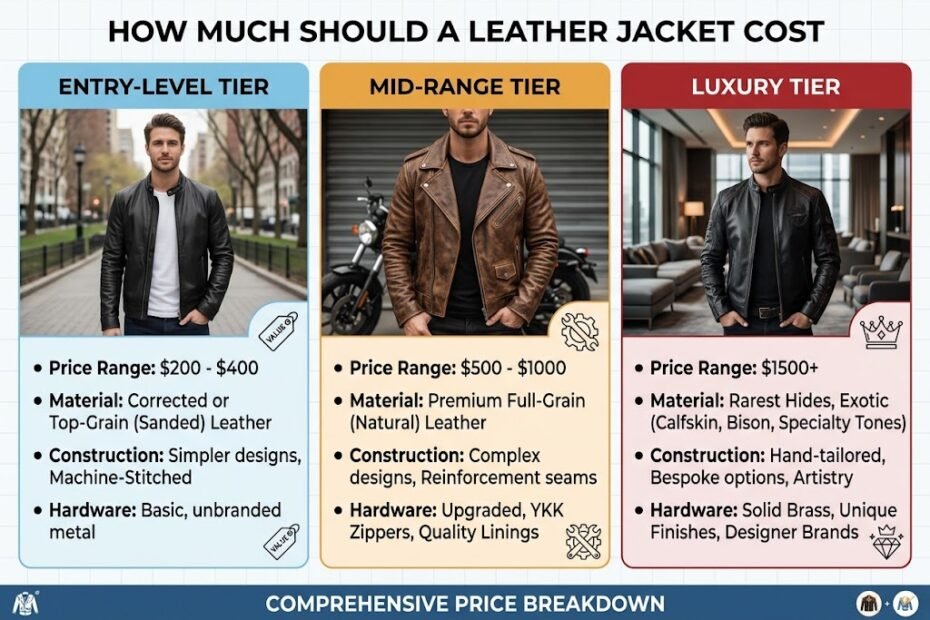
Investing in a genuine leather jacket is one of the most defining style decisions you will ever make. However, when you start browsing the market, the sheer disparity in retail pricing is immediately jarring. You will find budget jackets on fast-fashion racks priced under $100, direct-to-consumer options between $200 and $400, heritage workhorse pieces landing around $600 to $900, and designer runway luxury labels demanding $2,000 or more. Understanding how much should a leather jacket cost isn’t about simply finding the cheapest deal or assuming the highest price tag guarantees the best quality; it is about knowing what materials, craftsmanship, and structural durability you actually receive at every dollar threshold.
In 2026, the outerwear market has evolved dramatically. Direct-to-consumer manufacturing and advanced ethical tanning practices have eliminated costly middleman markups, making full-grain and top-grain hides more accessible than ever. At the same time, low-grade bonded leathers and disposable synthetic pieces continue to flood the market, masquerading as heirloom quality. To make an informed financial investment that pays dividends for decades, you need an objective breakdown of hide grades, hardware standards, and manufacturing ethics. This comprehensive guide breaks down the true cost of leather outerwear, revealing exactly how much should a leather jacket cost for your specific budget and style goals.
The Real Price Tiers: What Your Money Buys
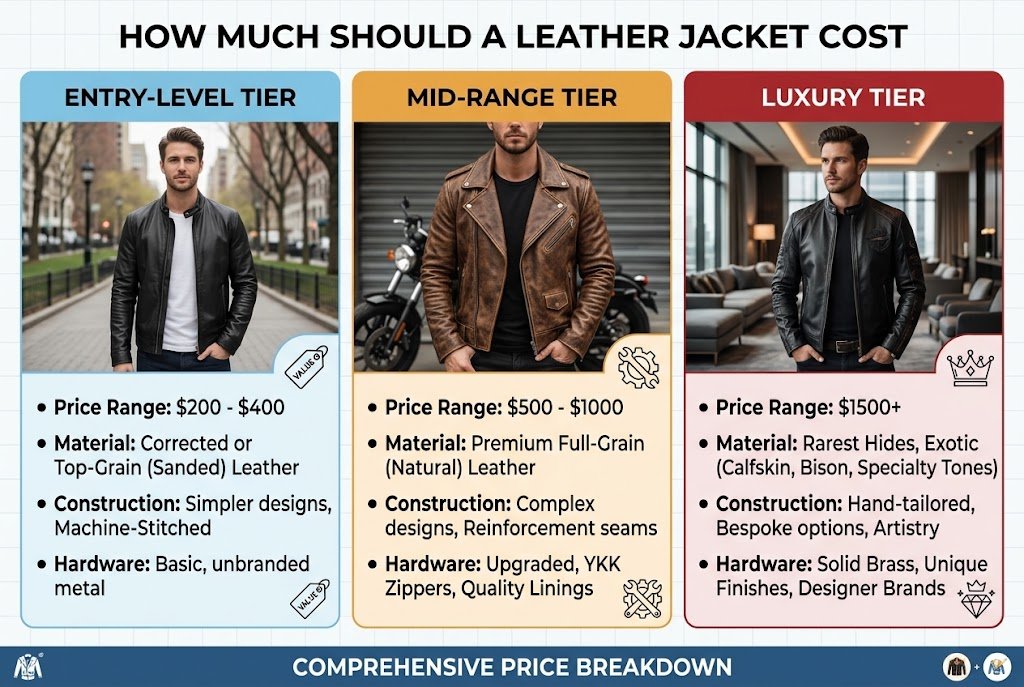
To navigate the retail landscape effectively, examine how leather jackets are segmented by price, material composition, and expected lifespan:
| Price Range | Hide Grade & Hardware | Average Lifespan | Value Proposition |
| Under $150 | Faux PU, PVC, or heavily coated bonded scrap leather | 1 to 2 years | Fast fashion; high risk of flaking and peeling. |
| $150 to $350 | Genuine top-grain lambskin or cowhide; YKK metal hardware | 5 to 10+ years | The Direct-to-Consumer Sweet Spot. Exceptional balance of quality and honest pricing. |
| $350 to $700 | Premium full-grain hides, vegetable tanning, heavy satin or wool lining | 10 to 20+ years | Premium craftsmanship, refined tailoring, and enduring durability. |
| $700 to $1,500 | Heavyweight heritage cowhide or horsehide; Made in USA/Italy | 20+ to Lifetime | Iconic heritage brands with heavy brand prestige. |
| $1,500 and Above | Exotic hides, bespoke tailoring, or luxury runway labels | Lifetime | Designer markup and luxury status symbol. |
For most shoppers, the true value intersection rests comfortably in the $200 to $500 range. In this bracket, direct-to-consumer brands can deliver authentic, durable hides without adding retail store overhead. To see curated options that maximize build quality without inflating price tags, explore our top recommendations in best affordable leather jackets 2026 buyers trust.
Core Factors That Determine the Price Tag
When evaluating how much should a leather jacket cost, five structural and logistical components directly dictate the final retail price:
Hide Selection and Grading
The raw animal hide represents the largest raw material cost in jacket production. Full-grain leather—which retains the intact outer layer of the hide with all its natural grain, breathability, and strength—is the most expensive to source because only the cleanest, unblemished hides can be used. Top-grain leather is lightly sanded to remove minor surface imperfections, offering a more uniform, pliable finish at a slightly lower material cost. Bottom-tier “genuine leather” utilizes split layers bonded with synthetic polyurethane coatings, which cost significantly less but lack durability. To understand how hide processing affects garment lifespan, read our in-depth comparison on top grain vs full grain leather.
Tanning and Finishing Methods
How the raw hide is preserved impacts both the price and the character of the finished garment. Chrome tanning is fast, cost-effective, and produces soft, water-resistant leather in a matter of days. Vegetable tanning, which utilizes natural tree barks, plant tannins, and artisanal drum dyeing over several months, requires significantly more labor and time. Vegetable-tanned jackets carry a higher upfront cost but reward the wearer with a rich, unique patina that deepens with every year of wear.
Hardware and Zippers
A premium hide is useless if the zipper breaks after six months. Premium jackets in the $250+ category utilize heavy-duty, anti-corrosive brass or nickel zippers (such as industrial YKK zippers), reinforced metal snaps, and smooth buckle closures. Cheaper jackets cut production costs by using lightweight zinc-alloy or plastic zippers that jam and pull apart under tension.
Interior Lining and Insulation
The interior lining accounts for a significant portion of daily comfort. Budget jackets use cheap, non-breathable polyester linings that trap sweat and tear easily at the armpit seams. Mid-range and premium jackets feature breathable viscose, heavy-duty twill cotton, or luxurious quilted thermal linings. For winter specific silhouettes, thick natural shearling linings naturally increase the price point due to the raw material density. To learn how internal fabric construction impacts insulation and drape, consult our breakdown on leather jacket lining materials.
Pattern Complexity and Panel Construction
A leather jacket constructed from large, seamless panels of unbroken hide requires pristine leather cuts and results in higher scrap waste, raising production costs. Lower-cost jackets often stitch together dozens of small scrap pieces with excessive horizontal seams to keep material costs down. While intricate stitching can be a stylistic choice, cleaner, larger panel cuts require higher-grade hides and superior tailoring precision.
Cost Per Wear: The Smart Way to Calculate Value
When contemplating how much should a leather jacket cost, smart buyers look beyond the initial purchase price and calculate the Cost Per Wear (CPW).
- The Cheap Alternative: A $90 faux leather jacket worn 30 times before the collar flakes and peels costs $3.00 per wear.
- The Smart Investment: A $300 genuine lambskin or cowhide jacket worn 60 times a year over a 10-year lifespan (600 total wears) costs $0.50 per wear.
An authentic leather jacket is one of the rare fashion purchases that genuinely gets better with age. As the leather softens and conforms to your body, its value increases while your effective daily cost plummets. To understand why quality outerwear acts as an enduring financial asset in your closet, explore our complete analysis on the investment piece leather jacket philosophy.
Ready-to-Wear vs. Bespoke Tailoring Costs
If you have unique physical proportions, such as broad shoulders or long arms, off-the-rack sizing can sometimes cause fit compromises. Custom-tailored or made-to-measure leather jackets typically command a 30% to 50% premium over off-the-rack counterparts to cover custom pattern drafting and individual hand-assembly. To evaluate whether personalized measurements justify the added investment for your build, review our detailed guide on made to measure leather jacket cost metrics.
Internal and External Resources
To ensure your upcoming outerwear purchase is fully informed, explore these authority links:
- Internal: Navigating your first leather purchase? Find your ideal starting silhouette with our guide on what leather jacket should i buy first.
- Internal: Compare real hide performance versus synthetic alternatives in our guide on real leather vs faux leather.
- External: Visit the Leather Working Group to study ethical certification standards, environmental compliance, and hide traceability across global tanneries.
- External: Consult Britannica for detailed historical and economic overviews of leather manufacturing and garment trade evolution.
Conclusion
Knowing how much should a leather jacket cost empowers you to bypass cheap, peeling synthetics while avoiding unnecessary four-figure designer markups. By targeting the $200 to $500 direct-to-consumer sweet spot, you secure top-tier full-grain or top-grain hides, durable metal hardware, and comfortable linings that provide decades of rugged elegance. Factor in the long-term cost-per-wear benefits, evaluate your personal wardrobe needs honestly, and invest in a quality piece of craftsmanship you will wear proudly for a lifetime.