How are leather jackets made? In broad terms, the work happens in two connected stages: a tannery turns prepared animal hide into usable leather, then a garment maker selects the leather, lays out patterns, cuts panels, sews the shell and lining, adds hardware, and checks the finished jacket. The exact methods vary by leather, design, factory, and order; there is no single process that describes every jacket.
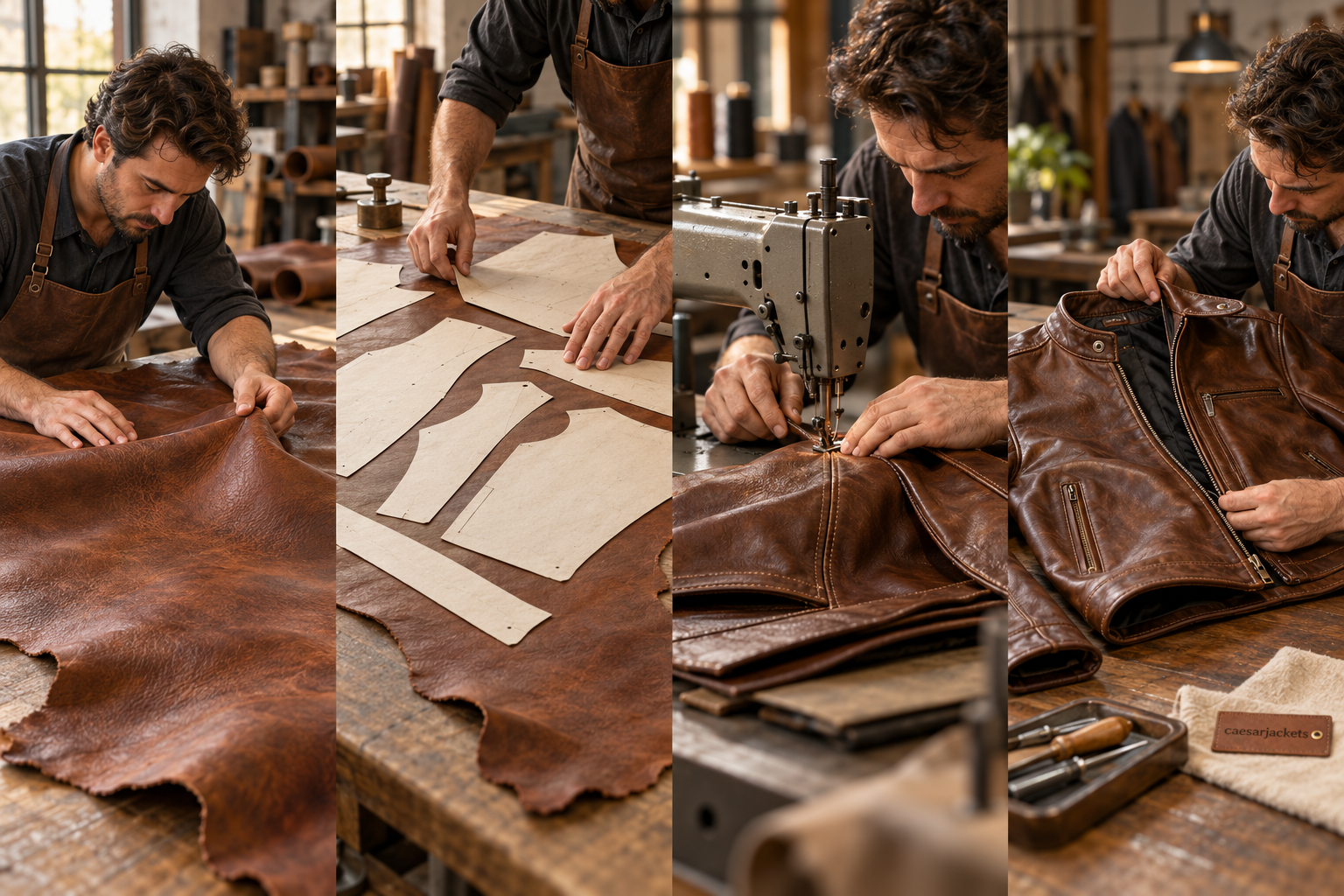
How Are Leather Jackets Made? The Two Stages
A finished jacket is not made directly from a raw hide. First, the hide is processed into leather at a tannery. Later, a garment factory or workshop turns that finished leather into a jacket. These businesses may be separate, and a brand may source materials and production from multiple suppliers.
Many hides enter the leather supply chain from animals raised for food, but sourcing arrangements vary. Claims about a particular jacket’s origin or factory should be checked with the seller rather than inferred from a general industry overview.
Stage One: Turning a Hide into Leather
1. Preparing and assessing the hide
Before tanning, hides are preserved and prepared for processing. Depending on their condition and the intended leather, preparation may involve soaking, cleaning, removing hair and flesh, and adjusting thickness. The hide is also assessed for natural marks, areas of variation, and usable surface.
These steps prepare the material; they do not make every hide identical. Animal source, thickness, natural marks, and later processing all contribute to variation. For a broader look at leather terminology and selection, see our leather jacket guide.
2. Tanning stabilizes the material
Tanning changes prepared hide into a more stable material suitable for leather goods. Tanners may use different tanning systems, including mineral-based and vegetable-based methods. The choice is not a simple quality ranking: the intended end use, desired properties, processing requirements, and supplier specifications matter too.
The Leather Naturally guide to modern leather making describes the progression from hide structure through tannery processes, leather properties, and control. Its process guide is useful for understanding leather production, but it should not be taken as a claim about how any particular jacket brand sources or processes its materials.
3. Finishing gives leather its final surface
After tanning, leather can be retanned, dyed, conditioned, dried, and finished according to its intended use. Finishing may affect color, hand feel, sheen, and surface protection. Some finishes preserve more visible natural grain; others create a more uniform appearance.
That is one reason the phrase “leather jacket” alone does not tell you enough about the material. When comparing options, check the animal source, grain or hide description, and finish. Our guide to choosing leather for a jacket explains how those characteristics relate to wearing preferences.
Stage Two: Turning Finished Leather into a Jacket
4. Design, measurements, and pattern development
A garment maker begins with a design and a set of pattern pieces for the jacket’s panels, collar, cuffs, pockets, and other components. The pattern must account for the intended fit, construction details, lining, and size range.
Patterns may be developed or adjusted digitally, on paper, or with a combination of tools. A sample may be made and reviewed before production, especially when a design or fit is new. Pattern and size specifications are important because leather panels do not behave exactly like ordinary woven fabric.
5. Selecting and laying out the leather
Before cutting, the leather is reviewed for usable areas, visible marks, thickness, color, and grain. The maker plans where each pattern piece will sit. This affects both material yield and how the finished jacket looks: two neighboring panels may be matched for a more consistent appearance, or natural variation may be retained when appropriate to the design.
The amount of leather required therefore depends on the pattern, jacket size, hide shape, and how much material can be used. A hide is not a uniform roll of fabric, so panel placement is part of the craft and production planning.
6. Cutting and preparing the panels
Once the layout is approved, the shell pieces are cut by hand, with cutting equipment, or through a combination of methods. Which method is used depends on the manufacturer and production setup. Cut panels may then be marked, paired, or checked against the pattern before assembly.
At this point, accuracy matters: an incorrectly cut piece can affect alignment, fit, or the way a seam comes together. Lining pieces and other components are cut separately using their own pattern shapes and material specifications.
7. Sewing the shell, lining, and details
The jacket’s panels are joined in a planned order. Makers assemble sections such as the front, back, sleeves, collar, and pockets, then add the lining and closures. The sewing machine, needle, thread, stitch length, and seam construction must be suitable for the material and design.
Not every jacket is made by one craftsperson from start to finish. Some workshops divide operations across a production team; others use a more individual or made-to-order approach. For example, Aero Leathers describes its own cutting, sewing, and final inspection process. That is one maker’s account, not a universal description of leather-jacket factories.
8. Adding hardware and completing the jacket
Zippers, snaps, buttons, buckles, and other trim are attached according to the design. The garment may then receive final finishing, cleaning, pressing or shaping where suitable, and preparation for packing. Details such as hardware placement and seam alignment contribute to how the jacket works and looks, but they do not independently prove the quality of the leather.
What Is Checked Before a Leather Jacket Is Finished?
How are leather jackets made to meet a particular quality level? Inspection can take place at several points, not just at the end. The exact checklist varies, but a buyer can look for evidence that the maker checks:
- Whether the leather and lining match the product specification
- Panel alignment, visible marks, and consistency of color or grain where required
- Stitching, seams, and attachment points around pockets and closures
- Zipper, snaps, buttons, and other hardware operation
- Measurements, fit, and symmetry against the approved design
- Loose threads, finishing details, and packaging condition
The Central Leather Research Institute’s leather garment manufacturing course outline includes raw-material selection, garment machinery, pattern design and grading, and quality control. These topics show why finished quality depends on both material and garment-making decisions.
For a practical buyer checklist covering construction and material signs, read our guide to assessing leather-jacket quality. The fit is another part of the finished product: use our leather jacket fit guide to check how the shoulders, chest, sleeves, and hem should sit.
What the Manufacturing Process Means for Buyers
Understanding how are leather jackets made can help you ask better questions, but a general process description cannot verify a specific brand’s factory, country of origin, labor conditions, or material claims. Look for a product listing that states the shell composition and gives meaningful details about the leather, lining, construction, and care.
If those details are missing, ask the seller before buying. A useful answer should be specific to the product—not a broad statement that all jackets are handmade, made from premium leather, or inspected to an unspecified standard.
Care also affects how the finished garment holds up. Follow the maker’s instructions for the particular leather and finish, and use our leather jacket care guide for general maintenance principles. To compare available styles and product specifications, browse the men’s leather jacket collection.
FAQ: How Are Leather Jackets Made?
Are leather jackets made from one piece of leather?
No. A jacket is usually assembled from multiple cut panels, along with separate lining and trim components. The number and shape of the pieces depend on the design, size, and construction.
Is tanning the same as making a leather jacket?
No. Tanning turns prepared hide into leather. Jacket manufacturing uses finished leather to create the garment through design, patterning, cutting, sewing, assembly, and inspection.
Are all leather jackets handmade?
No. Production methods differ. Some makers use team-based production, machinery, or digital pattern tools; others may use more individual or made-to-order steps. Check the seller’s description for evidence about the specific product.
How can I tell where a leather jacket was made?
Check the garment label, product listing, and seller’s origin disclosures. The general manufacturing process cannot establish the country, tannery, or factory used for a particular jacket.
From Hide to Finished Garment
How are leather jackets made? The short answer is that leather first goes through tanning and finishing, then a garment maker turns it into a jacket through pattern development, material selection, cutting, sewing, assembly, and inspection. The sequence and methods vary, so buyers should use process knowledge to ask precise product questions—not as a substitute for verified information about a specific jacket.