Investing in a premium genuine leather jacket is a transformative milestone for any wardrobe. Unlike generic canvas hoodies or oversized wool topcoats, real leather operates on an entirely different set of structural rules. It behaves less like a standard piece of fabric and more like a rugged second skin. It molds, stretches, and contours to your unique body frame over months of consistent wear, eventually creating a personalized silhouette that synthetic materials simply cannot replicate.
However, this organic adaptability creates a major point of anxiety for first-time buyers standing in front of the fitting room mirror. Because premium hides are stiff right off the factory floor, a brand-new jacket can feel surprisingly restrictive. This leads to a critical, age-old outerwear dilemma: how tight should a leather jacket be at first?
If your new coat feels like a rigid suit of armor, you are probably wondering whether you bought the wrong size or if it will naturally loosen up over time. Buying it too loose means it will look sloppy and boxy once it softens; buying it too small means it will permanently restrict your breathing and ruin your layering options.
To prevent a costly sizing mistake, let’s break down the definitive rules of leather tension, hide stretch, and structural alignment to ensure your investment looks flawless from day one.
The Firm Handshake Rule: Defining Initial Snugness
When zip-testing a brand-new piece of leather outerwear, the fit should feel like a firm, reassuring handshake across your torso—close, secure, but not suffocating.
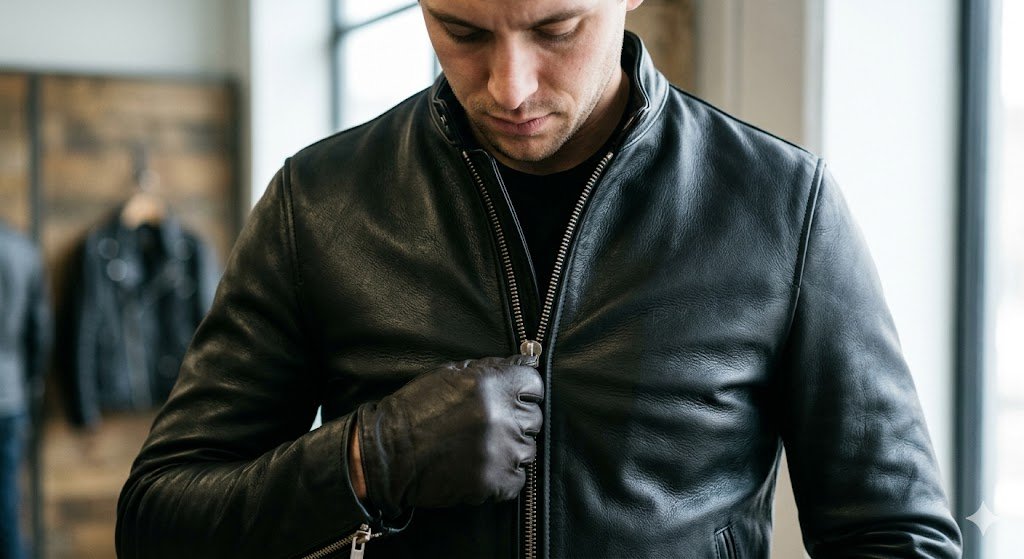
To answer how tight should a leather jacket be at first, you must look closely at how the leather drapes when fully fastened. The front panels should lay flat against your chest without bowing outward or creating deep horizontal stress creases. If the main zipper requires intense physical straining to close, or if you feel a sharp pinch in your ribs when breathing normally, the jacket is undeniably too small.
Conversely, if there are several inches of empty space floating between your stomach and the leather lining, the jacket is too large. Remember that leather relaxes as it breaks in; starting with a loose jacket will only result in an oversized, unpolished silhouette down the road.
The 3 Anchor Points: Where Tension Matters Most
To accurately judge how tight should a leather jacket be at first, you cannot focus entirely on the waist. You must audit three specific structural anchor points where the jacket connects to your skeletal frame.
1. The Shoulder Seam Alignment
The shoulder line is the most critical anchor point because it cannot be adjusted by a tailor. The seam where the sleeve connects to the shoulder panel must sit squarely on the outer edge of your natural shoulder bone.
The Correct Tension: The leather should sit flush against your shoulder blade. When you lift your arms to reach for a car steering wheel, you should feel a distinct pull across your upper back, but the seam itself should not slide inward toward your neck or droop down toward your bicep.
2. The Armhole Height and Pit Clearance
High-end tailoring relies on high, closely cut armholes to maximize arm mobility independently of the jacket’s torso. When evaluating how tight should a leather jacket be at first, the armholes should hug close to your armpits without digging in or cutting off your circulation. If the armholes are cut too low, lifting your arm will pull the entire waist of the jacket up past your beltline.
3. The Sleeve Length Break
With your arms resting naturally at your sides, the cuffs should terminate exactly at the base of your thumb. Because leather naturally develops deep horizontal wrinkles at the elbows through daily movement, the sleeves will permanently shorten by roughly half an inch over the first few months. Starting with a slightly longer sleeve ensures your wrists stay protected over time. If you need further help measuring your arm length, explore our dedicated leather jacket sleeve length guide.
Sizing Adaptability Across Different Animal Hides
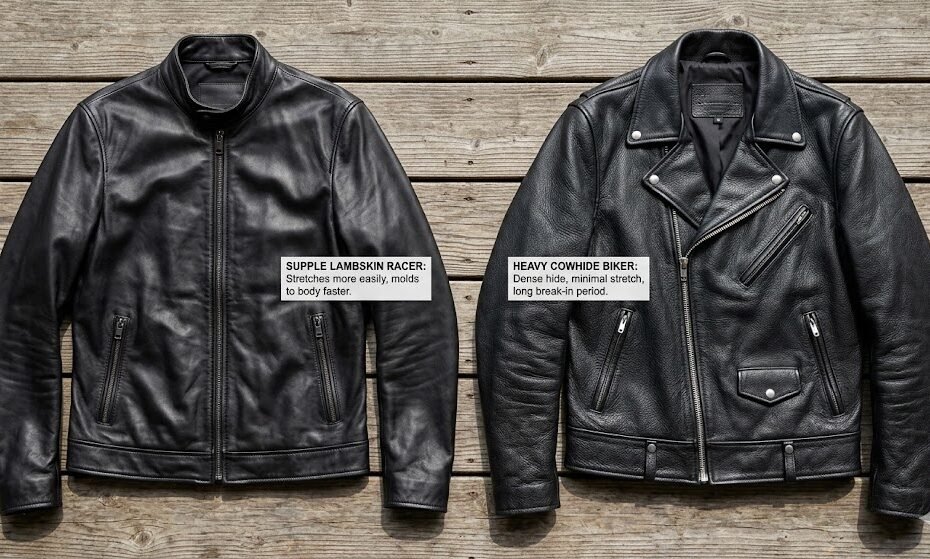
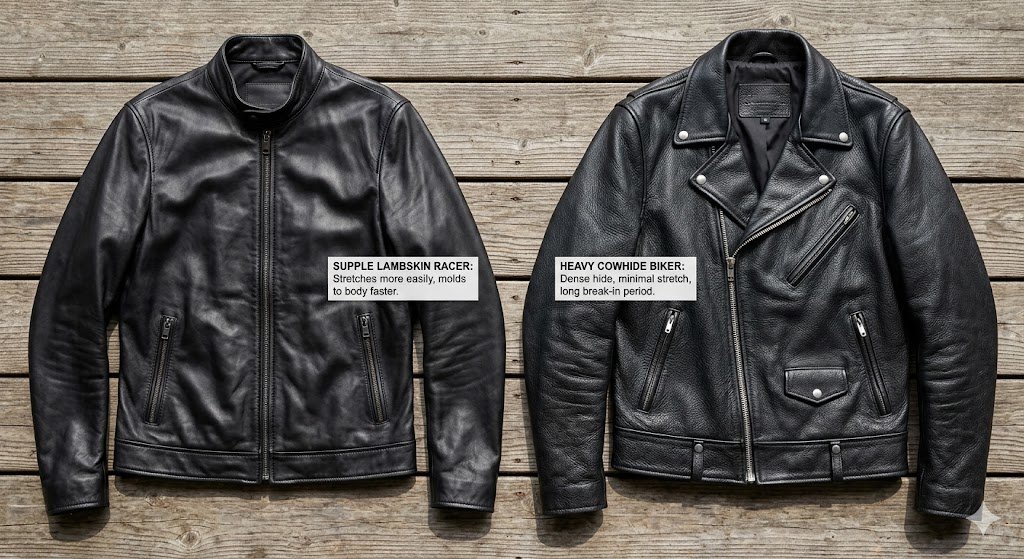
Not all animal skins stretch at the same rate. Understanding the biological density of your jacket’s hide is essential to figuring out how tight should a leather jacket be at first. According to material classification benchmarks verified by the Leather Working Group, the source animal changes the fiber elasticity completely.
[Image Location: Flat lay showcasing a supple lambskin racer jacket next to a heavy cowhide motorcycle jacket]
Alt Text: Comparing hide stretching capabilities to understand how tight should a leather jacket be at first
File Name: lambskin-vs-cowhide-fit-leather.jpg
Premium Lambskin and Sheepskin: These fine-grained hides are exceptionally soft, lightweight, and pliable right out of the box. Lambskin has an impressive natural elasticity and will stretch up to half a size to form a custom fit around your body shape. For a mens sheep leather jacket, you should favor an incredibly snug, form-fitting initial feel.
Heavy-Duty Cowhide and Buffalo Leather: These are thick, rigid, protective hides built to withstand intense wind resistance and long-term abrasions. Cowhide possesses very little natural stretch. While it will soften and drape better over time, it will not expand significantly in width. Therefore, a cowhide jacket needs to feel instantly comfortable and functional from the moment you purchase it. To see how these heavy hides adapt to harsh weather, see our analysis on whether leather jackets are warm enough for winter.
How to Conduct the 3-Step First-Time Sizing Audit
Before you remove the designer hangtags from your new jacket, perform these three physical tests at home to guarantee you have secured the perfect initial fit.
Test 1: The Hug Test
Zip the jacket up completely and wrap your arms tightly around yourself as if giving someone a hug. You should feel the leather stretch taut across your shoulder blades. If you can complete the hug easily with zero resistance, the jacket is too loose. If you cannot lift your arms high enough to cross your elbows, or if you feel like the back lining is about to rip, it is too tight.
Test 2: The Vertical Seam Tension Check
Stand sideways in front of a mirror and look at the main front zipper. If the zipper line forms an “X” shape or bends sharply inward across your stomach, the jacket is experiencing excessive tension. A perfectly fitting jacket should maintain a straight, clean vertical line down your torso.
Test 3: The Universal Layering Test
A classic mistake when deciding how tight should a leather jacket be at first is sizing it exclusively over a thin summer t-shirt. Always test the jacket over a standard knit sweater or midweight hoodie. The fit should feel snug but still allow you full range of motion. For those who love a relaxed streetwear look, reading our style guide on the perfect leather jacket over hoodie combination provides excellent context for balancing layers.
Real Leather vs. Synthetic Plastic Behavior
Your tolerance for initial tightness must also factor in whether the garment is authentic or synthetic. According to material longevity records curated by the Britannica Encyclopedia, real leather features an organic cellular structure that allows it to breathe and expand as pressure is applied.
Faux leather (PU or synthetic leather) behaves entirely differently. Because it is a polyester base coated in a solid layer of plastic, it has zero natural elasticity. Faux leather will never stretch or mold to your frame over time. If a synthetic jacket feels uncomfortably tight on day one, it will remain uncomfortably tight until the day the plastic begins to crack and peel away. To understand the exact financial and structural breakdown of this comparison, read our report on real leather vs vegan leather durability.
Summary Checklist for Sizing Certainty
| Sizing Metric | The Green Light (Perfect Fit) | The Red Flag (Size Up or Down) |
| Chest Tension | Feels like a firm handshake; lays flat | Causes zipper bowing, gasping, or deep pinching |
| Shoulder Line | Sits perfectly on the edge of the shoulder bone | Droops down the arm (Too big) or pulls toward neck (Too small) |
| Sleeve Length | Hits the base of your thumb when arms rest downward | Covers your knuckles or rises past your wrist bone |
| Hide Evolution | Softens, creases, and stretches up to half a size | Synthetic plastic remains rigid and eventually peels |
Find Your Flawless Fit with Caesar Jackets
Now that you understand exactly how tight should a leather jacket be at first, you can navigate your next purchase with absolute confidence. Premium leather is a lifelong companion, and choosing a piece that fits properly across your chest and shoulders ensures a striking silhouette for decades to come.
At Caesar Jackets, we bypass retail markups to bring you 100% genuine, ethically sourced leather jackets meticulously tailored to provide that coveted custom fit right out of the box.
Whether you want the bold, heritage presence of our iconic mens motorcycle jackets or the clean minimalism of our everyday mens casual jackets, our detailed sizing charts are designed to help you secure the perfect fit. Explore our new arrivals today and experience premium leather crafted to become your ultimate personal armor!