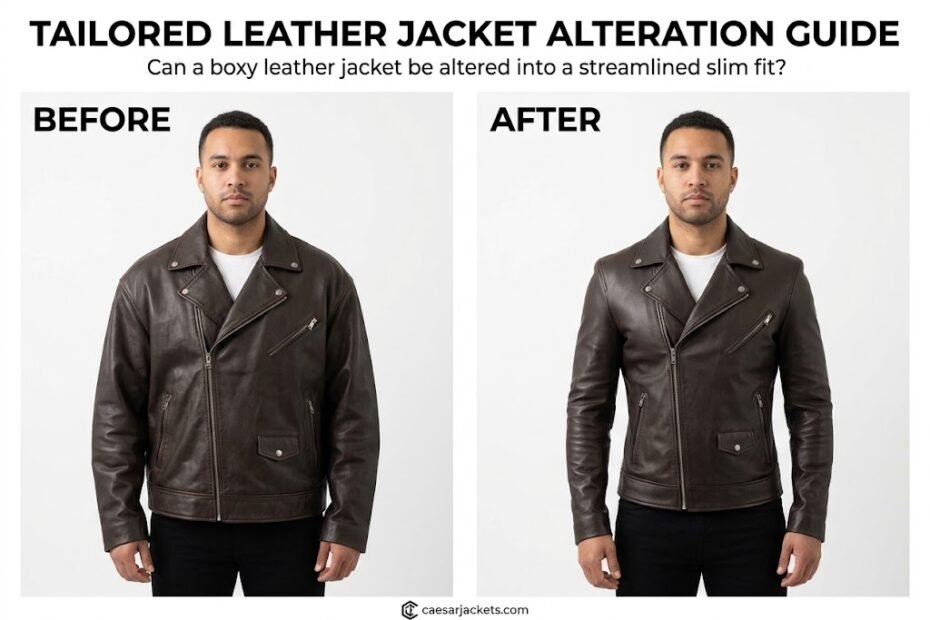
Acquiring a luxury leather jacket is an undeniable milestone in building a timeless menswear wardrobe. However, off-the-rack sizing rarely accounts for individual anatomical nuances. Perhaps you discovered an incredible vintage racer that is slightly too wide in the torso, lost weight after purchasing a heavy biker jacket, or inherited an heirloom piece with excessively long sleeves.
Faced with an imperfect fit, your immediate question is: can a leather jacket be altered like a traditional wool suit, or will taking shears and needles to animal hide permanently ruin the garment?
The definitive answer is: yes, a leather jacket can be altered, but only by a specialized master leather tailor and within strict physical constraints.
Unlike woven textiles such as cotton or denim, leather does not forgive mistakes. Every stitch punctures a permanent hole through the dermal membrane. In this 1,500-word masterclass, we break down the engineering limits of leather alteration, analyze what can and cannot be tailored, expose the pricing realities, and help you decide whether modifying your investment piece leather jacket makes financial and structural sense.
I. The Permanent Puncture Rule: Why Leather Tailoring Differs from Fabric
To understand why asking can a leather jacket be altered requires a specialized perspective, you must examine the material differences between woven fabrics and biological skin.
When an artisan alters a wool suit jacket, the needle passes between the warp and weft threads. If a seam is removed or let out, the threads shift back into place with steam and pressing. Leather, however, is a non-woven, dense matrix of collagen fibers.
According to technical standards published by the Leather Working Group (LWG), leather modifications are governed by three irreversible mechanical realities:
Permanent Needle Perforation: Leather sewing machines use specialized triangular or diamond-point “leather-point” needles designed to cut through tough hides. Every needle entry creates a permanent structural puncture. A botched seam cannot simply be undone, as the previous stitch holes remain visible and weaken the hide along that tear line.
Zero “Let-Out” Allowance: Standard cloth jackets contain extra fabric folded into the interior seam allowances to allow widening. Leather jackets are skived (shaved down at the edges) and trimmed flush during manufacturing to prevent bulky seams, meaning a leather jacket can almost never be made larger.
Lining & Hardware Complexities: Altering an outer leather panel requires deconstructing the inner leather jacket lining, moving heavy brass rivets, and resetting heavy-duty ykk vs sbs zippers without misaligning the front balance.
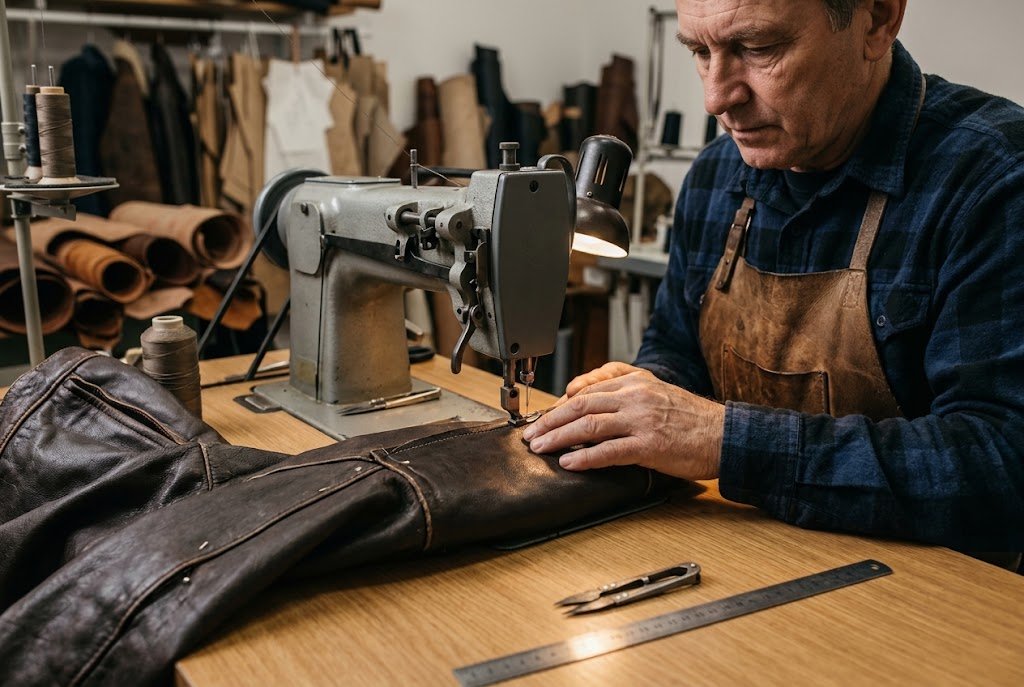
II. The Alteration Feasibility Matrix: What Can and Cannot Be Done
Knowing can a leather jacket be altered starts with identifying which structural adjustments are feasible versus those that risk destroying the garment’s silhouette.
| Modification Area | Feasibility | Technical Difficulty | What the Tailor Must Do |
| Shortening Plain Sleeves | High | Moderate | Cut from the cuff hem; easy on straight-cuff designs |
| Shortening Zippered Sleeves | Moderate | High | Must remove sleeve from the shoulder armhole or relocate zipper tracks |
| Tapering the Torso / Sides | High | Moderate | Taking in side seams to create a slim, tailored waist |
| Shortening Jacket Body Hem | Moderate | High | Requires repositioning the bottom zipper stop and resetting pockets |
| Narrowing the Shoulders | Extremely Low | Severe / Prohibitive | Requires total garment deconstruction; often distorts the chest drape |
| Enlarging / Widening Panels | Impossible | Non-Viable | Leather lacks interior inlay fabric; inserting gussets alters the silhouette |
According to tailoring benchmarks from the American Leather Chemists Association (ALCA), altering high-stress load-bearing points like the shoulder yoke alters the tensile distribution across the back, frequently causing the armhole seams to pull under everyday movement.
III. 4 Common Leather Alterations Explored in Detail
1. Shortening Sleeves (From the Wrist vs. Shoulder)
Excessively long sleeves are the most common complaint among off-the-rack buyers.
Simple Cuffs: If the sleeve has a plain cuff without zippers or snap buttons, shortening the length by 1 to 2 inches is straightforward. The tailor cuts the excess hide, skives the edge, and re-glues and stitches the new hem.
Zippered Moto Sleeves: If your sleeve features functional cuff zippers, shortening from the bottom requires removing and re-setting the zipper track, which increases labor costs. Alternatively, the tailor must detach the entire sleeve at the shoulder armhole, shorten from the top, and re-sew the sleeve head. Review our sizing baseline in the leather jacket fit guide to measure your arm drop accurately.
2. Taking In the Body (Tapering the Waist and Chest)
If the jacket fits well in the shoulders but billows loosely around the stomach, tapering the torso is highly effective.
The Process: The tailor opens the bottom lining, takes in the side seams by 1 to 3 inches, trims the interior excess hide, and top-stitches the new contour. This transforms an ill-fitting boxy cut into a sleek profile for leather jacket business casual settings.
3. Adjusting Shoulder Width (Why You Should Avoid It)
Many buyers ask can a leather jacket be altered across wide shoulders. While technically possible, it is rarely recommended.
The Problem: Shortening the shoulder seam requires detaching both sleeves, cutting down the front chest and back yoke panels, and recutting the armholes. This drastically changes how the collar rests against the neck and frequently introduces armhole pinching. If you have an athletic upper body, review our curated recommendations for best leather jacket for broad shoulders instead of modifying an ill-proportioned cut.
4. Lengthening Hem or Sleeves
Because leather is not woven, there is zero extra material hidden inside the hem allowance to let down. Attempting to add extension bands looks mismatched and ruins the visual balance of the original garment.
IV. The Financial Reality: Alteration Costs vs. Made-to-Measure
When researching can a leather jacket be altered, the financial cost is often the deciding factor:
Sleeve Shortening (Plain Hem): $80 – $140
Sleeve Shortening (Zipper Relocation / From Shoulder): $150 – $250
Taking in Side Seams (Torso Slimming): $120 – $220
Full Shoulder Reduction & Armhole Recut: $300 – $500+
If you purchase a vintage jacket for $150 and spend $350 on extensive structural tailoring, your total investment reaches $500 for a compromised, heavily patched garment.
Rather than spending money on high-risk tailoring, ordering custom sizing from the start guarantees clean lines and structural integrity. Take time to evaluate how our direct-to-consumer mens leather jackets and precision cuts eliminate the need for post-purchase alterations entirely.
V. Non-Invasive Sizing Adjustments: Stretching & Breaking In
Before committing to expensive alterations, consider whether natural leather conditioning can resolve minor fit issues:
Minor Fit Issue ──► Deep Conditioning ──► Targeted Manual Flexing ──► Natural Wear & Break-In Period
Supple Hides Stretch Naturally: Premium materials like what is lambskin leather and what is sheepskin leather naturally stretch up to half a size across high-tension areas (like the chest and elbows) as you wear them.
Conditioning for suppleness: Applying a lanolin-based conditioner relaxes the collagen fibers. Follow our guides on how to soften stiff leather and learn how to stretch a leather jacket safely at home.
Proper Break-In: Accelerate natural draping by following our step-by-step techniques to break in a new leather jacket fast, allowing thick what is cowhide leather to mold to your physique.
VI. FAQ: Critical Leather Alteration Questions
Can any local dry cleaner or tailor alter a leather jacket?
No. Never take a leather jacket to a standard dry-cleaning alterations shop. Regular sewing machines lack the torque to pierce multiple layers of hide, and round textile needles tear jagged holes into the leather. Always hire a dedicated leather specialist equipped with walking-foot industrial machines.
Can faux leather jackets be altered?
While synthetic PU can be stitched, alterations are rarely worth the investment. Needle punctures weaken the synthetic plastic coating, accelerating irreversible peeling leather jacket issues along the newly altered seams.
What should I do if a seam tears during or after an alteration?
If a stress point or stitch line gives way, do not attempt to fix it with superglue. Use dedicated leather adhesives and reinforcement sub-patches, or follow our detailed steps to repair leather jacket seams at home.
VII. Conclusion: Measure Twice, Cut Once
In conclusion, can a leather jacket be altered? Yes—adjusting sleeve lengths and tapering torso side seams are viable options when handled by a master leather specialist. However, structural modifications like narrowing shoulders or widening panels are high-risk, expensive, and often counterproductive.
At Caesar Jackets, we believe proper fit is the foundation of exceptional style. We bypass retail fashion markups to offer premium, artisan-crafted outerwear cut from 100% full-grain and top-grain hides. Whether you are seeking iconic mens motorcycle jackets, timeless mens bomber jackets, everyday mens casual jackets, or versatile mens classic jackets, our detailed sizing specifications ensure an ideal fit right out of the box.
Explore our curated palettes of classic black leather jackets, rich brown leather jackets, and tailored womens leather jackets to claim your perfect heirloom piece today.