Spilling fuel on a premium leather jacket or car seat is every enthusiast’s nightmare. Gasoline isn’t just a strong odor; it is a solvent that can strip the natural oils from animal hide, leading to permanent brittleness. If you are struggling with how to remove gasoline smell from leather, you must act quickly but cautiously to avoid chemical burns on the surface.
Because leather is a porous, fibrous material, the gasoline molecules anchor themselves deep within the grain. In this guide, we will break down the science of odor neutralization and provide six professional steps to restore your leather’s natural scent.
I. The Science: Why Gasoline is Dangerous for Leather
Gasoline is a petroleum distillate. According to the Leather Working Group (LWG) safety standards, volatile organic compounds (VOCs) like those found in fuel can dissolve the protective topcoats of aniline vs semi-aniline leather.
💡 CaesarJackets:The “Vapor Lock” Effect
When people try to scrub gasoline out with heavy soap, they often create a “Vapor Lock.” By saturating the surface with water and thick cleaners too early, you trap the volatile fuel molecules under a layer of moisture, forcing them deeper into the leather’s core. The secret to how to remove gasoline smell from leather is to encourage evaporation first, not to “seal” the smell in with wet cleaning.
II. 6 Methods to Remove Gasoline Smell
| Method | Best For | The Process |
| 1. Cornstarch/Baking Soda | Fresh Spills | Cover the area with dry powder for 24 hours to wick out the liquid fuel. |
| 2. Activated Charcoal | Stubborn Odors | Place the jacket in a box with charcoal bags; do not let charcoal touch the leather. |
| 3. Distilled Vinegar | pH Neutralization | A 50/50 water-vinegar mist helps break down the petroleum base. |
| 4. Enzyme Cleaners | Deep Saturation | Use a specialized leather-safe enzyme that “eats” the organic fuel compounds. |
| 5. Coffee Grounds | Dark Leathers | Dry grounds absorb the scent and replace it with a neutral earthy aroma. |
| 6. The Wind-Tunnel | All Scenarios | Hang the jacket in a breezy, shaded area to allow VOCs to off-gas naturally. |
III. Step-by-Step Restoration Process
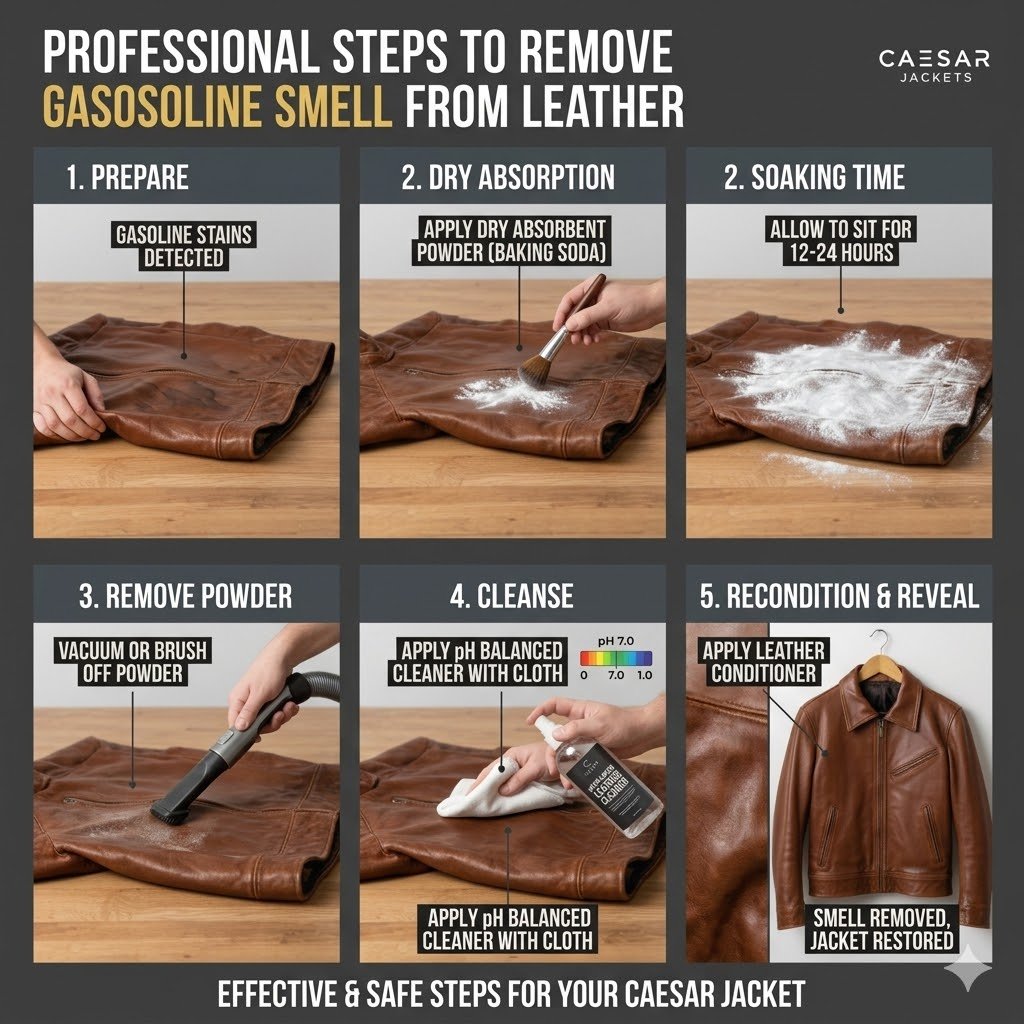
If you have a premium cowhide jacket or a soft sheepskin piece, follow this order:
Blot, Don’t Rub: Use a paper towel to lift as much liquid as possible. Rubbing pushes the gasoline into the fibers.
Dry Absorption: Apply a thick layer of cornstarch. This is safer than the methods used for removing cigarette smells because it focuses on liquid extraction.
Ventilation: Hang the jacket outside but away from direct sunlight to avoid sun fading.
Conditioning (Crucial): Gasoline will leave your leather bone-dry. You must follow up with our guide on how to stop leather from cracking to replenish the oils.
IV. Maintenance After a Fuel Spill
Even after the smell is gone, the structural integrity of the hide may be compromised.
Check for Stiffness: If the fuel has made the area rigid, refer to our tutorial on how to soften stiff leather.
Wrinkle Repair: The chemical reaction can sometimes cause the grain to distort. See how to remove wrinkles from leather safely.
Surface Protection: Once clean, apply a protector to ensure the aging process continues naturally without the interference of chemical residues.
V. FAQ: Gasoline and Leather Care
Can I wash my jacket in the machine to remove the smell?
Absolutely not. As we noted in can you wash a leather jacket, total immersion will ruin the hide and won’t effectively dissolve the petroleum.
Does real leather retain the smell longer than faux?
Yes, because real leather vs vegan leather durability comes from its porous nature. Fake leather is plastic and can often be wiped clean, but real hides require a deeper neutralization process.
What if the smell persists for weeks?
If DIY methods fail, it may have reached the inner lining. You may need a professional cleaner who specializes in petroleum extraction.
VI. Conclusion: Patience is the Key to Recovery
Mastering how to remove gasoline smell from leather is a test of patience. By focusing on evaporation and absorption rather than harsh scrubbing, you can save your investment piece leather jacket.
At Caesar Jackets, we build our garments with high-quality, resilient hides, but even the best leather needs a helping hand when accidents happen. For more tips on maintaining your jacket’s pristine condition, consult our Ultimate Leather Jacket Guide.