If you are wondering how to remove wrinkles from leather, start with the care label—not heat. For a light fold in a leather jacket, hang it on a sturdy, broad, padded hanger, gently reshape the garment by hand, and give it time. Do not assume that steam, an iron, a hair dryer, or conditioner is safe for every leather finish. If the crease is sharp, the material is unfamiliar, or the surface changes, stop and consult a leather-care professional.
This guide focuses on leather jackets and garments. Bags, shoes, furniture, and leather-look materials may need different care, so follow the maker’s instructions for those items.
Identify the leather and finish before treating a crease
Terms such as cowhide, lambskin, and sheepskin describe the animal hide; they do not, by themselves, tell you how its surface was finished. A smooth, coated jacket and an uncoated or suede garment can react differently to moisture, friction, and heat—even if they use the same type of hide.
Check the care label and product information first. If the finish is unknown, treat the jacket as delicate. For more background, see our guides to cowhide leather, lambskin leather, and aniline and semi-aniline finishes.
| Material or finish | What to watch for | Safer first step |
|---|---|---|
| Smooth, finished leather | Moisture or concentrated heat may change the color, sheen, or surface finish. | Try a broad hanger, gentle reshaping, and time. Follow the garment label. |
| Aniline or lightly finished leather | The surface may be more vulnerable to water marks, darkening, or color transfer. | Avoid improvised moisture or heat treatments; ask the maker or a leather specialist if the crease remains. |
| Suede or nubuck | Moisture, pressure, or rubbing may mark the surface or flatten its nap. | Hang gently and allow time. Use only care products and tools specified for suede or nubuck. |
| Patent, coated, or bonded material | Heat or pressure may affect the coating or cause surface changes; construction varies. | Do not use steam or an iron unless the product instructions explicitly permit it. |
| Shearling, fur, or wool-lined garments | Moisture and heat may affect the lining, trim, or the way joined materials sit. | Keep the garment away from DIY heat and consult the maker or a specialist for stubborn creases. |
How to remove wrinkles from leather with the lowest-risk first step
1. Hang and gently reshape the garment
Empty the pockets and place the jacket on a sturdy, broad, padded hanger that supports the shoulders. Smooth the lining and sleeves into their natural position, then use your hands to ease the folded area back into shape without pulling hard or stretching the leather.
Leave the jacket in a cool, dry, well-ventilated place with room around it. Check it after a day or two; a light packing crease may relax, but there is no guaranteed time or result. Avoid wire hangers, tight closets, direct sunlight, and radiators. Our leather jacket storage tips cover longer-term storage.
2. Wear it normally only if it feels comfortable
For a mild fold, ordinary movement while wearing a comfortable, properly fitting jacket may help it settle naturally. Do not force the material into position, repeatedly pull at the crease, or wear a jacket that feels tight in order to stretch it.
Steam: why it is not a default DIY method
A steamy bathroom is sometimes suggested as a way to soften creases, but it is not a universal or guaranteed-safe treatment. Ambient humidity can still affect some finishes, and direct steam can expose a small area to concentrated moisture and heat. Do not point a garment steamer at leather or assume that a method suitable for one jacket is suitable for another.
Only consider a steam-related method if the garment’s care instructions specifically allow it, and follow those instructions exactly. If the label is silent or the finish is unknown, skip it. Be especially cautious with suede, nubuck, lightly finished leather, coated surfaces, and garments with shearling or other attached trim.
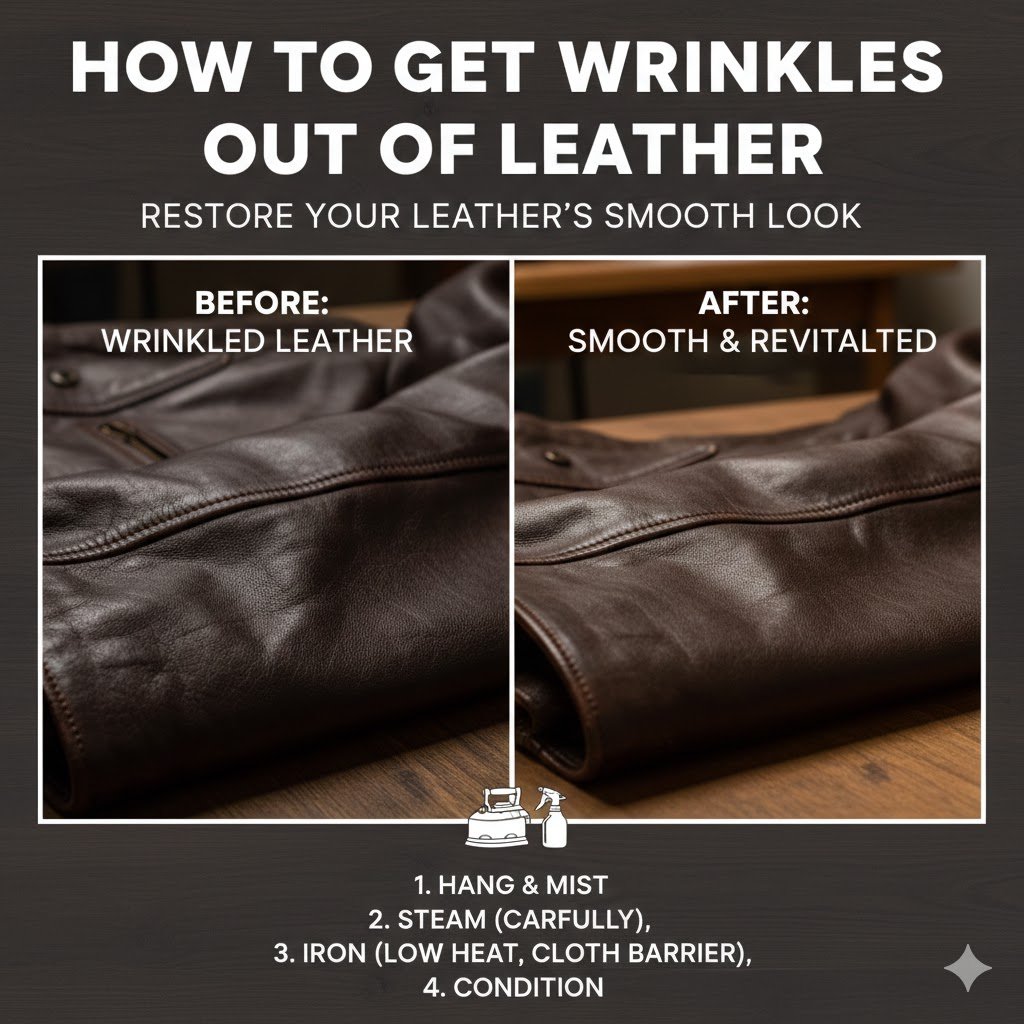
Ironing: do not treat “low heat” as a universal safe setting
We do not recommend home ironing as a general solution for leather wrinkles. “Low” varies between irons, and a household iron concentrates heat in one spot. A cloth barrier does not guarantee that the leather or its finish will be protected.
If the care label prohibits ironing—or does not clearly permit it—do not iron the garment. If the maker explicitly provides ironing instructions, follow that product-specific guidance rather than a generic online temperature or technique. When in doubt, use a leather-care professional.
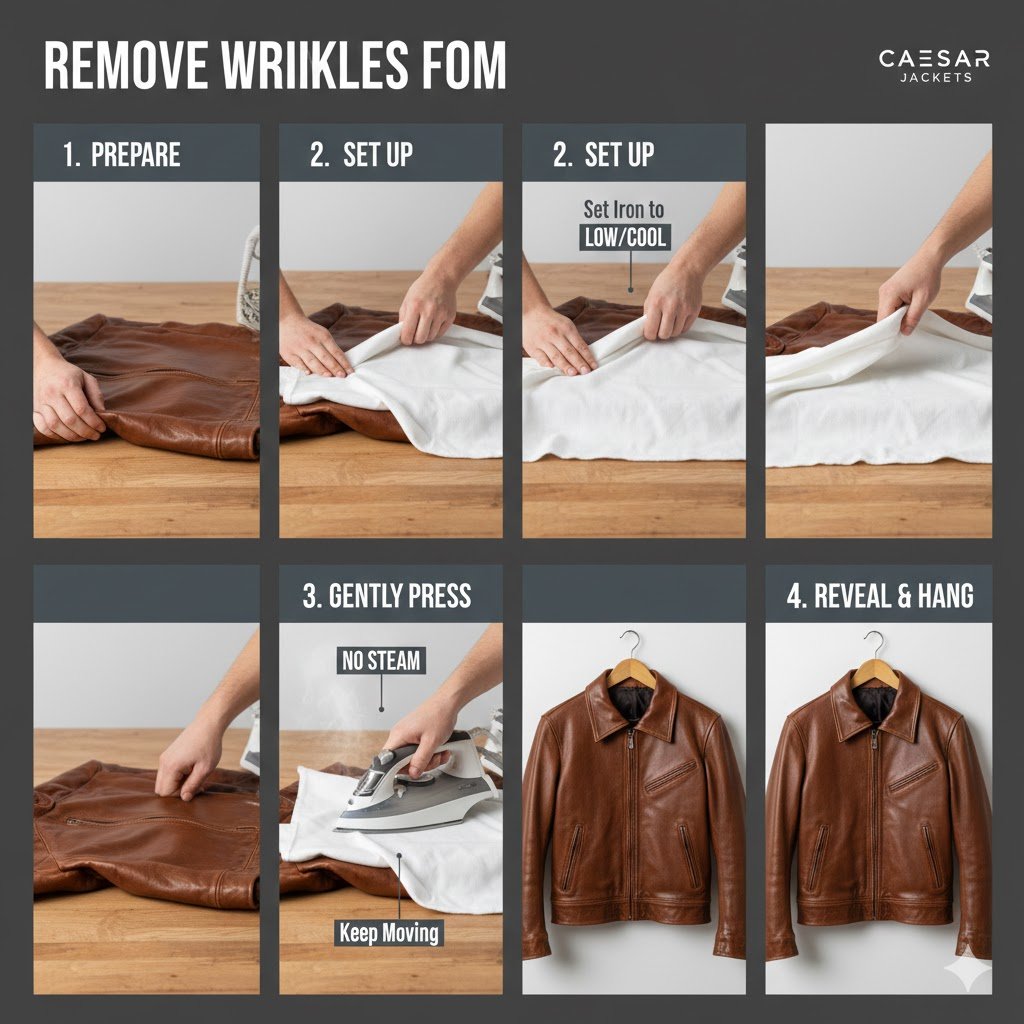
Care instructions vary by product. For example, Belstaff’s leather-care guidance says to avoid ironing and forced drying, while BMW Motorrad’s leather-clothing instructions advise against ironing and recommend drying at room temperature away from radiators and direct sun. These are examples, not a substitute for the instructions supplied with your own garment.
Methods to avoid unless the maker explicitly approves them
- Hair dryers and heaters: Do not use them to warm or dry a crease. Uncontrolled heat may affect the leather or finish.
- Heavy objects: Do not press books or other weights onto the garment. They may leave pressure marks or flatten texture.
- Unapproved conditioner: Conditioner is not a wrinkle remover or a repair for heat damage. Use one only if it is suitable for the leather and the maker’s instructions allow it.
- Repeated pulling or rubbing: Stop if the surface looks shiny, changes color, feels tacky, or begins to crack.
If the garment is dirty as well as creased, do not scrub the fold to make it disappear. See our guide on how to clean leather jackets and follow the product’s care instructions.
When to stop and contact a leather-care professional
Seek specialist help if the crease is deep or sharply set, if the jacket is valuable or sentimental, or if you cannot identify its finish. Stop DIY treatment immediately if you notice color transfer, darkening, a change in sheen, a flattened suede nap, coating wrinkles, peeling, tackiness, or cracking.
Some folds from shipping or storage may soften without disappearing completely. Creases at elbows and other high-movement areas may be part of normal wear. If the leather has also become stiff or cracked, do not try to solve both problems with heat or extra conditioner; see our guides to softening stiff leather and repairing cracked leather, or consult a specialist.
Frequently asked questions
Can I use a clothes steamer on a leather jacket?
Do not use direct steam unless the jacket’s care instructions explicitly permit it. If the label is unclear, skip steaming and ask the maker or a leather-care professional.
Can I iron leather on the lowest setting?
Not as a general DIY method. A low setting is not a universal temperature, and a protective cloth does not remove the risk. Only follow ironing instructions supplied for that specific garment.
How long should I leave a leather jacket hanging?
Start with a day or two on a broad, padded hanger in a well-ventilated room. Light folds may relax, but deeper creases may remain. Do not add heat or pressure if the first gentle approach does not work.
Should I apply conditioner to remove wrinkles?
No. Conditioner is not a wrinkle-removal treatment. Use it only when appropriate for the leather and in accordance with the manufacturer’s care guidance.
Can deep creases be removed completely?
Not always. The result depends on the material, finish, and how the crease formed. A leather-care professional can assess the garment before attempting treatment.
Care for the garment, not just the crease
For light folds, begin with a suitable hanger, gentle reshaping, and time. Avoid assuming that steam, ironing, heat, or conditioner is safe for every leather type. When the care label is missing, the finish is uncertain, or the crease is severe, professional advice is the safer next step. For ongoing care, visit our leather jacket care guide.