Capturing the heavy, sleek, and reflective essence of leather on paper or a digital canvas can be incredibly intimidating. Unlike regular cotton or wool, leather has a unique weight, stretches distinctly at the joints, and features high-contrast highlights that give it that signature premium sheen. Learning how to draw leather jacket textures is a fundamental skill for fashion illustrators, comic artists, and concept designers alike.
In 2026, realistic texturing in character art has taken center stage, driven by advanced digital brushes and high-definition concept art trends. Whether you are sketching with a traditional pencil or painting in Procreate, understanding the physical architecture and light behavior of real hides is the secret to success. This step-by-step guide breaks down the process into manageable phases to help you master the look perfectly.
Map the Silhouette and Structural Form
Before you can think about the shiny finish, you must build the structural foundation of the garment. The biggest mistake artists make when learning how to draw leather jacket styles is sketching it too thin, making it look like a casual shirt.
Account for Thickness: Real leather is dense. The lines outlining the shoulders, collar, and lapels should be bold and geometric. Drop the shoulder seams slightly if you are drawing a modern, stylized look. For structural inspiration, explore our mens leather jacket styles breakdown.
Establish Major Components: Block out the large shapes—the wide asymmetrical lapels of a black motorcycle jacket, the thick cuffs, and the heavy waistband.
Draft the Heavy Creases and Folds
Leather does not fold into tight, paper-thin wrinkles like silk or cotton. Instead, it forms thick, rounded, pipe-like creases due to the density of the hide.
The Joint Points: Focus your fold lines heavily around the inner elbows, the armpits, and where the elbows bend.
Draw “Pipe” Folds: Use curved, overlapping lines rather than sharp, straight zig-zags. These rounded folds communicate the material’s thickness to the viewer’s eye. If you are drawing a snug fit, make sure the creases pull horizontally across the button or zipper line. Check our leather jacket fit guide to see exactly where real jackets tension on a human frame.
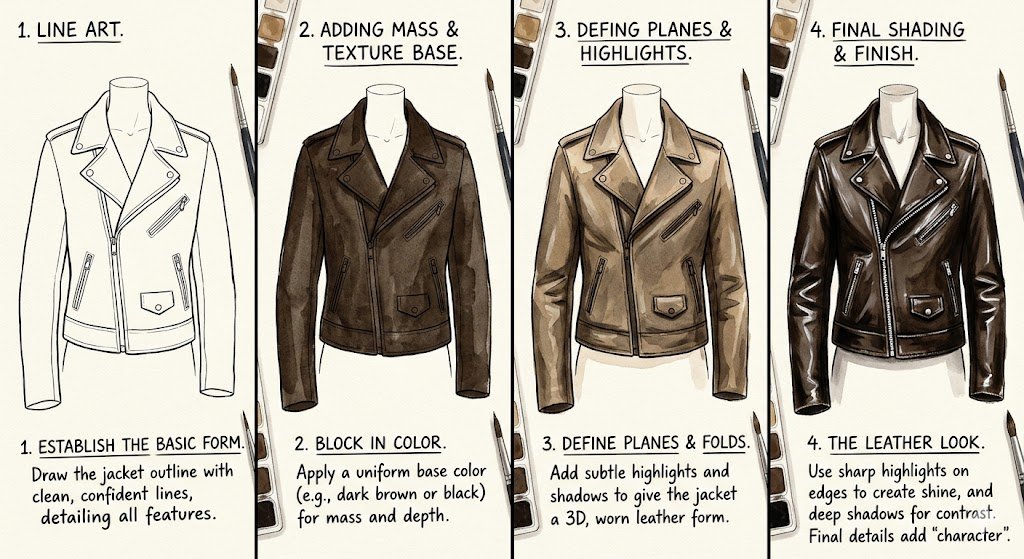
Apply the Base Value and Block the Deep Shadows
Once your line art is clean, it is time to establish the lighting. For a classic appearance, start with a mid-tone gray or a rich, dark sepia if you are rendering an earthy tone.
If you are rendering a vintage look, consider blocking in warm tones. See our how to style a brown leather jacket style guide to understand how shadows deepen on distressed brown hides.
Render the High-Contrast Highlights
This is the magical step when learning how to draw leather jacket textures where the material suddenly transforms from flat fabric into real leather. Leather acts as a semi-reflective surface, meaning it catches bright, sharp light along its edges.
Identify the Light Source: Determine exactly where your light is coming from. Place sharp, bright white or light grey streaks along the crests of the rounded elbow creases, the top rims of the shoulders, and the edges of the lapels.
Keep the Highlights Sharp: Do not blend your highlights out completely. The transition from the dark base leather to the bright highlight should be relatively abrupt and crisp to simulate a smooth, reflective grain finish.
Add Hardware Details and Texture Imperfections
To make your drawing truly believable, you need to add final secondary details. A clean, perfectly unblemished coat looks digital and artificial; real leather has character.
Draw the Hardware: Use a sharp, high-contrast silver white to sketch the zippers, buttons, and belt buckles. Give them tiny black drop shadows to make them pop off the chest.
Stitch Lines: Draw subtle, dashed parallel lines along the seams of the shoulders, collar, and pockets to simulate industrial stitching.
Micro-Texture: If drawing digitally, use a fine noise or grain brush at a very low opacity over the mid-tones to replicate the natural pores of cowhide leather.
Internal and External Resources
To expand your fashion knowledge and further ground your artwork in real-world details, explore these links:
Internal: Learn about the sleek texture of different hides by reading our guide on lambskin vs sheepskin leather.
Internal: Need drawing references for specific ensembles? Check out our visual style guide on outfits with leather jacket men love to wear.
External: Visit the Leather Working Group to study how different tanning processes alter the surface textures and reflective qualities of real hides.
External: Consult Google Search Central to discover top-ranking digital art communities and pro rendering tutorials.
Conclusion
Understanding how to draw leather jacket garments boils down to observing light physics and physical weight. By capturing the thick, pipe-like creases around the joints and layering sharp, unblended highlights against deep, blocked shadows, you can easily trick the eye into seeing a premium, heavy material. Keep practicing your contrast balances, pay close attention to the metal hardware details, and watch your fashion illustrations come to life.