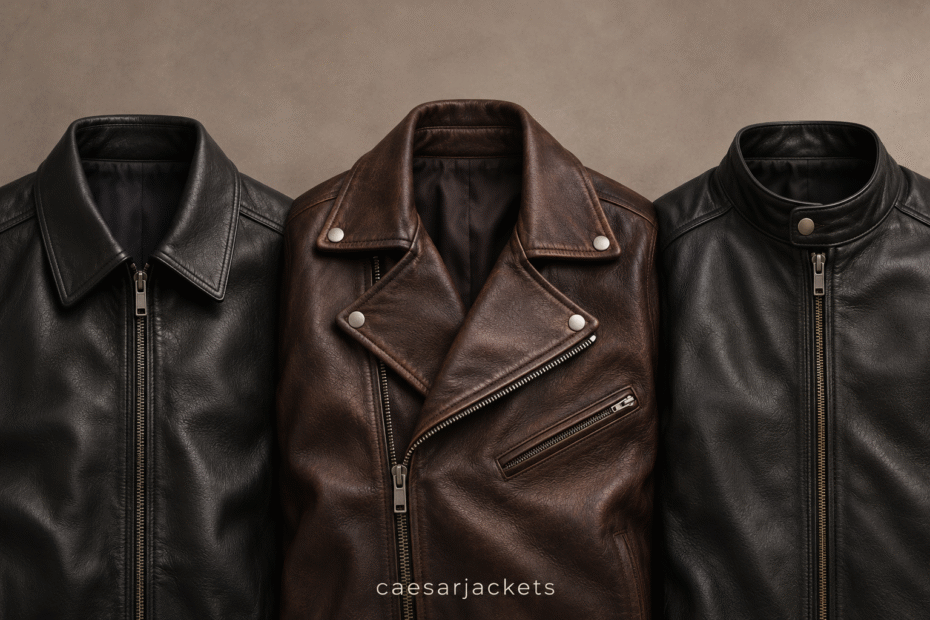
Leather jacket collar types change how a jacket frames your face, layers over a shirt, and reads across casual or polished outfits. The collar is a small pattern detail with an outsized effect: a broad lapel looks assertive, a shirt collar feels familiar, and a short stand collar keeps the outline clean. Knowing the main shapes makes it easier to choose a jacket you will reach for often.
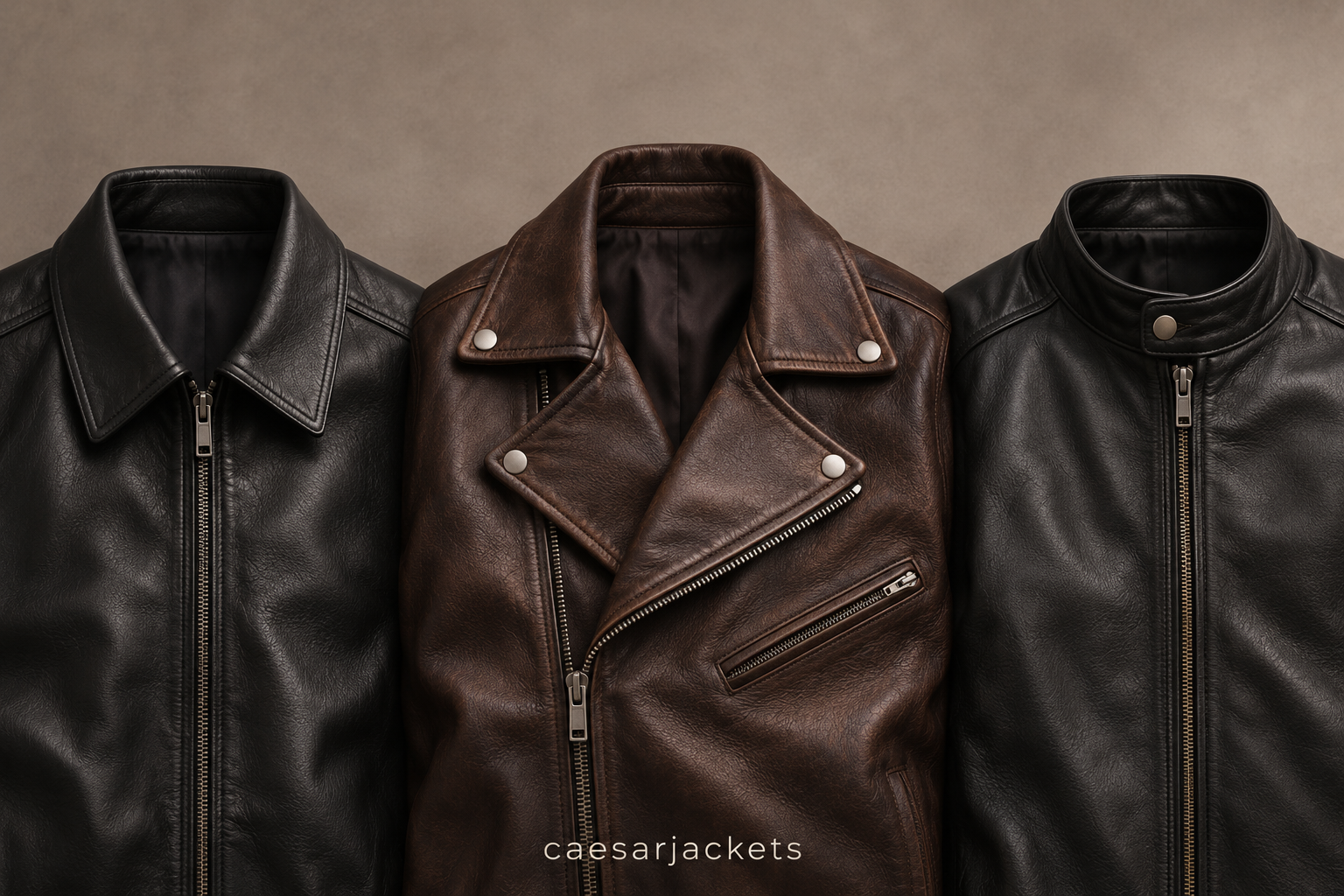
The main leather jacket collar types
Shirt collar
A shirt collar has two points that fold down much like the collar on an everyday button-down. It is one of the most versatile choices because it sits comfortably over a T-shirt, knit, or collared shirt without adding much bulk. On a trucker-inspired or casual leather jacket, it gives the design a relaxed, familiar character.
Check the collar points while the jacket is zipped and open. They should lie flat rather than curl outward, and the collar stand should not press into your neck when you turn your head. A softer leather may drape more easily; a firmer hide tends to keep a sharper outline.
Notched lapel
A notched lapel is formed by a collar that meets the jacket front at a visible notch. It is common on single-breasted fashion jackets and some tailored leather designs. The open shape creates a broader frame around the chest, so it can make a simple outfit look more intentional without requiring extra accessories.
This shape works well over a crewneck or fine-gauge sweater. If you plan to wear a scarf, test the combination: a large lapel and a bulky scarf can crowd the neckline. For a quieter silhouette, choose a narrower lapel and a jacket that closes neatly at the front.
Biker lapel collar
A classic biker collar uses wide, pointed lapels, often with snaps that hold them down when the jacket is open or moving. The asymmetrical zipper and hardware make the collar part of the jacket’s visual identity. It pairs naturally with plain shirts and restrained accessories because the front already has strong lines.
The lapels should sit evenly when fastened. If they flap or pull, the issue may be the jacket’s chest fit rather than the collar itself. For commuting or everyday wear, consider whether you prefer the full lapel look or a more minimal front before choosing a biker style.
Stand collar
A stand collar rises around the base of the neck instead of folding into points. Café racer and minimalist jackets often use this shape, sometimes with a snap tab. It gives a streamlined appearance and leaves less fabric around the neckline, which can be comfortable beneath a helmet or a close-fitting outer layer.
A stand collar needs the right neck opening. When zipped, it should close without rubbing the throat or forcing your chin forward. If you often wear thick scarves, allow enough room or choose a model with a lower, softer collar.
Band or mandarin collar
A band collar is a short strip that circles the neckline without traditional lapels or pointed ends. It looks clean and contemporary, especially on simple zip-front designs. Because there is less structure at the neck, it puts more focus on the jacket’s shoulder line, leather finish, and hardware.
The terms “band” and “mandarin” are sometimes used loosely by retailers. Look at the actual garment photos and measurements rather than relying on the label alone: collar height and closure placement vary by maker.
How to choose a collar for your wardrobe
Start with what you wear under the jacket. A shirt collar is the easiest all-rounder for mixed layers. A stand collar keeps the neckline compact. Broad biker lapels add a strong focal point, while notched lapels balance casual and tailored pieces. A band collar is a good fit when you want a restrained, modern outline.
Then check proportion and comfort in a mirror. The collar should complement your shoulder width and face without forcing a “rule” about body type. Zip the jacket, sit down, and turn your head. Notice whether the collar bunches under a scarf, catches against your chin, or leaves an awkward gap at the neck.
Leather also affects the result. A structured jacket holds its collar shape; a softer one tends to sit closer to the body. For a broader understanding of leather grades and terminology, see the Leather Working Group’s resources. For a general overview of leather as a material, Encyclopaedia Britannica’s leather entry provides useful background.
Common collar-shopping mistakes
- Choosing from a product name alone. Terms can vary across brands. Inspect front, side, and zipped photos.
- Ignoring the closed position. A collar that looks good laid flat may feel restrictive when the jacket is zipped.
- Adding too many competing details. Wide lapels, prominent hardware, a patterned shirt, and a bulky scarf can all compete for attention.
- Assuming collar style determines warmth. Warmth depends more on fit, lining, leather, wind exposure, and what you layer underneath.
If you are comparing silhouettes, browse men’s leather jackets or women’s leather jackets and compare the neckline details alongside fit and closure.
A quick way to decide
Choose a shirt collar for flexibility, a biker lapel for a bold classic, a stand collar for a clean close fit, a notched lapel for a slightly tailored look, or a band collar for minimal styling. The best leather jacket collar types are the ones that stay comfortable when fastened and work with the layers you already wear. If possible, try the jacket both zipped and open before making a final choice.