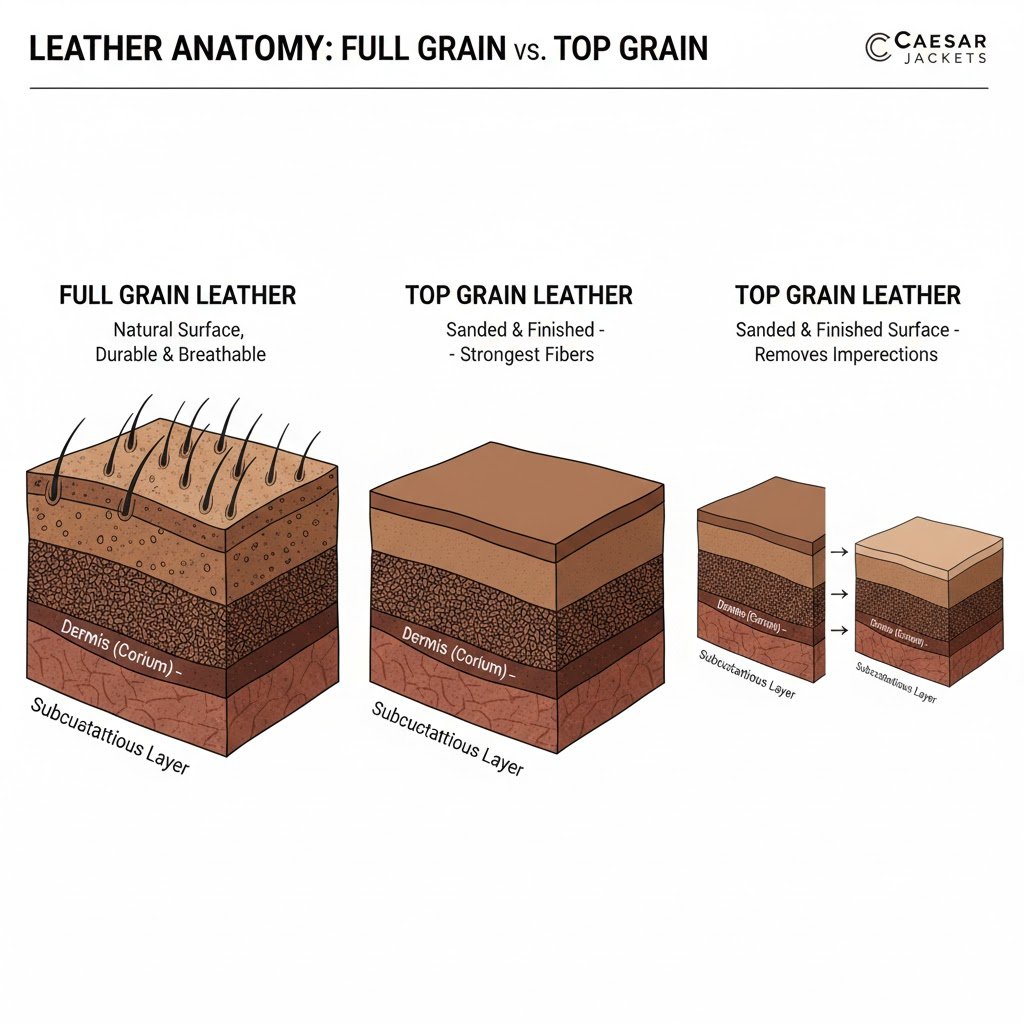
In a top grain vs full grain leather comparison, the main difference is whether the natural grain surface is retained or has been mechanically corrected, such as by buffing. That can affect the leather’s visible texture and finish, but it does not by itself determine a jacket’s overall quality, lifespan, softness, or price. Hide type, thickness, tanning, finishing, construction, and care matter too.
There is also a terminology detail buyers should know: “top grain” is used differently in technical and retail contexts. In this guide, it refers to the corrected or buffed grain commonly contrasted with full grain in consumer listings. Check how a seller defines the term for a specific jacket.
Top Grain vs Full Grain Leather: What the Terms Mean
What is full grain leather?
Full grain leather retains its original grain surface, without that surface being removed by corrective mechanical treatment. Natural variations may remain visible, but they are not a quality score on their own. The hide, tanning, finish, and the way the jacket is made all contribute to the finished product.
What does top grain mean in jacket listings?
In many consumer comparisons, “top grain” means grain leather that has been buffed or otherwise corrected to create a more uniform surface. In stricter technical usage, top grain can refer more broadly to the upper grain layer, including leather whose grain has not been corrected.
The Leather Working Group terminology list defines full grain as leather that has kept its entire grain, and distinguishes corrected grain as leather whose grain has been partially removed by buffing or similar treatment. The Leather Research Laboratory’s explanation of full grain and top grain notes that “top grain” may also be used more broadly for the grain split. For a practical top grain vs full grain leather comparison, it helps to confirm which meaning a product listing intends.
How They Compare for Leather Jackets
The table below compares top grain vs full grain leather in a jacket-buying context. These are general distinctions, not guarantees about every leather or garment.
| Factor | Full grain | Corrected grain, often marketed as top grain |
|---|---|---|
| Surface treatment | The natural grain surface is retained without corrective mechanical removal. | The grain surface may be buffed or otherwise corrected to reduce some visible marks. |
| Appearance | Natural variation may be visible. The look can change with wear, depending on the finish. | The surface may appear more uniform, depending on the correction and finishing treatment. |
| Feel and weight | Not automatically thicker or stiffer. Feel depends on the hide, thickness, tanning, finish, and lining. | Not automatically thinner, lighter, or softer. Check the jacket’s actual specifications and fit. |
| Durability | The label does not guarantee a particular lifespan. Construction, use, and care also matter. | Correction alone does not determine how long a jacket will last. |
| Care | Follow the maker’s care instructions. Natural-looking surfaces may show wear differently from coated finishes. | Care depends on the finish. Do not assume every corrected surface is stain-resistant or easier to clean. |
| Price | Some full-grain products cost more, but the label alone does not establish the price. | Price depends on hide, finish, tanning, construction, and brand—not only the grain term. |
| Jacket use | May suit buyers who prefer visible natural variation and want to see how the surface wears. | May suit buyers who prefer a more consistent appearance, if the specific jacket’s feel and construction work for them. |
A useful top grain vs full grain leather comparison separates documented material details from assumptions. Neither label alone proves a jacket will be softer, more stain-resistant, or longer-lasting. To compare prices fairly, look at jackets with similar hide types, thicknesses, linings, hardware, and construction. If a listing does not identify the grain treatment, do not infer it from the price or appearance.
Full Grain, Corrected Grain, and Split Leather
These terms describe different aspects of leather. Full grain describes a grain surface that has not been removed by corrective mechanical treatment. Corrected grain describes grain that has been partially removed through buffing or a similar process. Split leather is a layer separated from the hide during splitting; it is not simply another name for corrected grain.
A product described as “genuine leather” does not, by that phrase alone, tell you whether it is full grain, corrected grain, or split leather. If the exact surface or hide layer is important to you, look for a clear material description or ask the seller.
When a listing is unclear, ask whether “top grain” means corrected grain or simply the upper grain layer. This makes any top grain vs full grain leather comparison more useful than relying on the term alone.
How to Check a Leather Claim Before Buying
- Read the material description. Look for the hide type and whether the grain is described as full, corrected, or otherwise finished.
- Ask what “top grain” means. Confirm whether the surface has been buffed or corrected rather than relying on the phrase alone.
- Inspect more than one area. Natural variation can differ across a hide, and finishes can change how much texture is visible.
- Avoid destructive tests. Cutting, burning, or applying liquids can damage the jacket and may not reliably establish its leather type.
- Compare the whole garment. Check fit, lining, stitching, hardware, and care instructions alongside the material description.
For more practical checks, see our guide on how to identify full grain leather. Visual clues can help you ask better questions, but they do not replace clear product information.
Which Leather Should You Choose for a Jacket?
Choosing top grain vs full grain leather for a jacket is best treated as a preference about surface character—not a shortcut for judging the whole garment. Compare the stated material, finish, construction, care instructions, and fit.
Consider full grain if you prefer a natural surface
Full grain may suit you if you like visible variation and want to see how the surface changes with wear. Before buying, confirm the hide and finish and check whether the jacket’s weight and feel fit how you plan to wear it. The term alone does not guarantee a “lifetime” garment.
Consider corrected grain if you prefer a more uniform look
A corrected surface may suit you if you prefer a more consistent appearance. Ask what treatment was used and review the specific jacket’s feel and care instructions. Do not assume it will always be softer, lighter, cheaper, or more resistant to stains; those qualities depend on the leather and finish.
For a practical top grain vs full grain leather buying decision, compare the actual product details rather than choosing by label alone. You can browse our men’s leather jackets and check each listing’s stated materials and specifications. The category is for shopping; this guide is for understanding leather terms.
Care Tips for Either Type
Follow the care instructions for the specific jacket, since the surface finish can affect how it should be cleaned. Keep leather away from prolonged heat, and check that a cleaner or conditioner is suitable for the material before applying it. For general routines, see our leather jacket care guide.
Frequently Asked Questions
How should I compare top grain vs full grain leather when buying a jacket?
Check how the seller defines the term, whether the surface has been corrected, and what other material and construction details are disclosed. If those details are missing, ask before relying on the label to predict quality or lifespan.
Is top grain leather the same as corrected grain?
Not in every context. “Top grain” may refer broadly to the upper grain layer, while consumer comparisons often use it to mean a corrected or buffed surface. Check how the seller defines the term.
Does full grain leather always last longer?
No fixed lifespan follows from the label alone. Wear, construction, hide, finish, climate, and care all affect how a jacket holds up. Avoid treating claims such as “lasts decades” as guarantees unless they are supported by evidence for that specific product.
Is full grain leather always more expensive?
No. Price depends on more than the grain description, including hide type, thickness, tanning, finishing, garment construction, and brand. Compare products with similar specifications rather than relying on the label alone.
Bottom Line
In a top grain vs full grain leather comparison, focus on what the seller means by the term and how the surface was treated. Full grain retains its natural grain surface; “top grain” may be used broadly or as shorthand for corrected grain. Compare the jacket’s material details, finish, construction, care needs, and fit before deciding which one suits you.